The most complicated outcomes have been the two plates that catastrophically failed in the kiln. I was just rushing the firing process and the plates hadn’t thoroughly dried through, evidently. They were two good plates I had made on a Friday afternoon in the art room, after school mainly, one of which experimented with symmetry, almost. To make it worse I printed out a couple of good photographs with the intention of possibly considering a replica and when I showed people they said, ‘wow, they were great’ which just made me feel worse.

It does bring them into the category of Lost Artwork along with all of the others, known and unknown. I mourn them but haven’t got round to replicating them. I could do. The photos are clear and I could and then they would be in the category of replica art works, known and unknown. I like that idea but things have moved on, I have cast new moulds, found new things in the cupboard to press into the clay and so on. Latest thing is a woodcut from the Far East found at the back of a cupboard. This has been fun with slip painted on it and banged into the clay, sprinkled with oxide.

What made the getting out of the broken plates with a brush and dustpan more painful was that I had made three plates which were supposed to look as if they were toying with destruction or their own demise. Sprinkled with raw oxides and dripped with poured slips and so on. These were supposed to look like they were close to falling apart but obviously not fall apart. These were responding to seeing some work in the Halesworth Gallery that uses artfully placed raw materials by Kyle Kirkpatrick, a concert of a late Beethoven quartet at Snape and the news of a family bereavement.

I haven’t fired these yet. I have got anxious about firing and I am leaving the plates a lot longer to dry out. There are fourteen raw plates waiting for a biscuit fire. Mostly sprig based accumulations, termed Art Room Excavations. Thats what they are based on; finding things around the classroom and in the cupboards and pressing it onto plates. They are supposed to look archeological objects.

One of the problems that students have with reflective writing is to decide on relevance and disclosure. What information is relevant? What should be included? How wide does one draw the circle around the project? How much do you need to tell?

As we live in difficult times and some of that must impact on the work somewhere then do I have to write up notes on Bin Laden or Clegg? The background buzz of history going about its business, rearranging the zeitgeist. I can’t say I’ve made a plate about that as yet.

The last few days have been difficult and odd and that probably has impacted on the plates so that does need to be written about, in some way.

Not much time to work on any plates today due to other commitments and having to administer maths test which took me out of the art room. I did have time to work on a ‘mind map’ of ideas about how one becomes an art teacher whilst the children sweated over their tests.

Or how this art teacher became one anyway. One of the themes in the work, quite a difficult theme to get across really, is the blind alley, the inappropriate model, the lack of a mentor, the poor advice that can have quite an effect on ones progress through all of this. There are so many people who have very fixed ideas about what they mean about ‘standards’ and ‘skills’ in art that their advice can have a deleterious effect on the young artist. Not to mention the ‘common sense’ views of art that plague one as one is growing up and that are still heard with amazing regularity, in Lowestoft anyway.

It is a testament to the ineffectiveness of decades of art teaching that so many people still hold the view that it ain’t a proper picture if you can’t tell what it is. This is in contrast to the millions who pack Tate Modern and the whole idea of building galleries in godforsaken towns to magically regenerate them. Is this generational? Or is it class based?

But, whatever the ins and outs of all that is, the main point as far as this is concerned is the act of making the maps of influences and tracks of progress or not. Learning journeys tend to be presented as an onward march of progress towards whatever happy, sunny upland the learner currently views the world from but that isn’t the case at all. Well, not for this learner. We are talking here about years of wasted time making paintings that were no use to anyone. Unsold and unloved things. One of the problems students have with the notion of the ‘reflective learner’ is negotiating with the idea that their honest reflections are assessment suicide if they own up to not getting it.

Thinking about ‘not getting it’ or not being told what it was to get and so on made me think more about the people who had been there along the way and I start thinking there’s a plate in that and another one in that. What is a plate about Roger Dean going to look like? Pretty far out, I should think. That wouldn’t have occurred to me without the mapping exercise. The process excavates ideas.

The kiln cooled down this morning and Shirley got a set of plates out. They looked pretty good. I’ll photograph them all tomorrow.

Carlos came in today and spent the day printmaking for his exhibition at the Halesworth Gallery later in the year. He pointed out to me that my having him work in the room and showing him printing techniques is also part of the life of the room. Which it is. Carlos is an architect form Peru, married to a friend and colleague, and making his way in Suffolk. Today we were trying to make a screen print work.

I also worked on three plates today. One crank plate had been in three bin bags since before Easter but was still workable and I finished that off with further sprigs, impressed pattern and some carefully rubbed on green slip along raised surfaces which brought out some of the writing and textures on the biscuits very well. I also made Ray Johnson rabbit plate with green slip. The year sevens I worked with this morning made mail art cards to send to Leiston Middle and I made a couple of demonstrations cards so Ray Johnson has come round again. I didn’t quite finish it but it will have ‘Add to and Return to Mr Cope’ carved into it tomorrow.

I also worked on a blank at home this evening. Another ‘Off Task’ plate. Productive doodling about. .

Back to school. Not really got my head going so lots of doodly things in the sketchbook. A sort of marking time. Not really got going again and this doodling about seems to be part of getting things to move about in my mind again. Today doodling around Hundertwasser. The Y8 have been doing a little watercolour project on the old hippy as an end of term thing so we are just finishing that off. I am also sorting through a massive archive of art cuttings given to me by Gerald including a cutting of Hundertwasser from a Sunday supplement when he was having a show at the Barbican. Incredible as he couldn’t get arrested now. Apart from Taschen no one has much time for him. I use him as a quiet watercolour layering, imaginative drawing task. Part of my Deeply Unfashionable Artist series.

This evening I painted a plate with underglazes in a vaguely Hundertwassery way to see how watercoloury the underglazes can be. I made an image to commemorate yesterdays 35 mile bike ride to Covehithe. This afternoon I stayed behind and made a quick Sprigtastic plate with two clays. A buff school clay for the plate and a crank for the sprigs. I have so many sprigs I can make a whole set in a few minutes and put them on a plate relatively quickly. There is something of a series of sprig plates going now. I glazed some this afternoon whilst Y8 were painting ready to fire the kiln tomorrow.

One of the things which I think is very difficult to capture in this sort of research writing is the theme or idea that slowly comes into focus from something unconsidered into something important. It requires a degree of prophecy in the record keeping or almost a 1:1 ration of record to action which is more or less impossible to do.

A good example of this in this project is the role of Lowestoft Porcelain in the work. I was aware of the existence of the factory in Lowestoft and its local importance and it was one of the factors in the idea to make commemorative plates. I knew that they had made some of the first seaside souvenirs and that tied in with the idea of seaside ceramics and collectibles as part of the commemorative plate concept. I had seen the displays at the Norwich Castle Museum and I had made that connection but no more. It was a background part of the general idea. There seemed to be something of a seafaring and naval theme to some of the pots I was referencing in general and the cult of the naval captain such as Keppel and Nelson used in the earlier plates.

My technician, Shirley, told me that I should talk to David, one of our caretakers, about Lowestoft Porcelain as he was something of a local expert. David had told me a bit about the factory before and he had told me about the early pots with “A Trifle From Lowestoft” written on them; some of the earliest seaside souvenirs. There are also pots with bathing machines on them.

Some of the early plates got A Trifle From Lowestoft inscribed on them after talking to David. Later on he bought in a book to show me about the collection in the Castle Museum (Smith, Sheenah 1975 Lowestoft Porcelain in Norwich Castle Museum- Volume 1, Blue and White Norwich Castle Museum, Norwich). I did a set of drawings from this and photocopied the borders and put them in the journal. I used these on the edges of some plates and I made one plate with a lot of these border designs going across the surface.

David has taken to coming through the art room first on his rounds to see what I have been doing. He has been fascinated by watching someone grapple with these pre-industrial ceramic techniques that I have been using in the project. And every day there has been something new. David has bought in plate from his collection to show me.

Because of David I now have two further books about Lowestoft Porcelain and he has kept me in touch with developments in the local collecting scene. It seems that Davis has been collecting since 1974 and has owned and traded a lot of Lowestoft Porcelain in his time.

On the last day of term he took me to an auction of Lowestoft Porcelain at the Beaconsfield Club in Lowestoft, run by Russell Sprake. In the centre of a horse show of tables was a long table with all of the lots set out. I sat at the outside tables and helpers would bring out the lots for inspection so one could handle and examine the lots. Some people were asking to look at all of the lots but I was too shy for that and just asked for the coffee cans and the tea bowls and some of the plates. Handling the ware was very interesting. They are heavier and more solid than the idea of porcelain leads you to expect and the qualities of the pots were highly variable. there was a beautiful custard cup (Lot 84 in the catalogue) which was very appealing.

As the auction went on I realised that I was sitting amongst a set of experts on the ware. It is a community of collectors with a huge amount of knowledge about the ware and the history. I realised that one of the reasons we were there was to get more knowledge about the ware. People were sitting there handling and examining all of the lots in sequence with no hope or interest in buying a great number of lots. The handling and the examining is part of building up a knowledge, a touch, a feel for the ware. I was fascinated by the idea of people deliberately building their knowledge by touch in this way. It made me think about how one learns about this sort of thing. I was really looking hard at the things I handled, really trying to impress them onto my mind somehow. Whipping out a sketchbook seemed probably the wrong thing to do but that’s very much what I wanted to do. The process of drawing is part of the imprinting for me. Recording it on paper records it onto my mind as well. People were enjoying the touch and feel of the pottery. There is a definite thrill to holding something made 200 years ago that could live in a museum case.

I realised that part of the appeal is the varied quality and levels of production. The ware goes from very simple and quite primitive blue and white ware to much more sophisticated polychrome ware made later in the life of the factory. This embodies the history of the factory. There isn’t that much to go on which is also part of the attraction. The factory didn’t leave a pattern or very good records so much of what is known has been deduced from what ware exists and what has been excavated during a couple of digs when gas mains went in and new buildings were put up on the site of the cottages and kiln which constituted the factory.

I had picked up from the Sheenah (1975) book that the patterns started off very simply and then worked their way up to more complex variations made up of multiple uses of the simpler themes. I had deduced from this that there was a possibly a training element to this and this would seem to be true. A few key painters and potters came from London, probably Bow, and bought some expertise but many of the painters were drawn from the local fishing and farming communities. Many would have been children so this is building up of expertise is built into the decoration of the ware. There is learning in the history of the ware as the factory and the people in it got better at what they were doing.

In the terms of the times they were fantastically successful. They lasted for forty years and stopped when the original investors got too old to be bothered with it. They never went bankrupt which was a common outcome for many pottery factories of the time. They survived by being flexible, innovative and happy to copy too.

The auctioneer made some reference to a piece of damage on a pot being a minor firing accident ‘all those years ago’ and I realised that is part of the attraction for the collectors, that connection with the past in the processes and hand touches of the makers.

I did bid on a couple of things but not very well. At the end David spoke to Sprake about the pot that I hadn’t bid up to the reserve and he agreed to sell it to me for the reserve price of £60 so I have become a collector. I am the owner of a small Lowestoft Porcelain tea bowl, Lot 6, Small blue & white teabowl, Mansfield pattern, crescent mark. I have been inculcated.

How do you learn about something like this? Every collector there has there own story about what piqued their interest and drew them in. This would appear to be mine.

In March I also made a blue and white plate with a design of a Lowestoft fish smoker smoking some herring on tenter hooks over a fire. I used a Lowestoft Porcelain border and I wrote ‘Made at Lowestoft Mar 24th In the presence of D. Sturman’ for David. This is in reference to the the pots in Norwich Museum, made as samplers, with ‘Made in the presence of R. Browne’. This pot came out of the kiln this week with a nice clear glaze on it. I shall give it to David once it has been exhibited somewhere as part of the project. He hasn’t seen it yet.

It is to thank David for his input into the plates, of course, and his showing me Lowestoft Porcelain. It is also supposed to be about the people involved in the project. I remember making a spider gram about some art work last year as an example for the summer school at SARU and being surprised about how it became about the people I had met in the making of the work. In this reflective writing, continually examining the inside of ones own head, it is possible to forget the interactions and the people that you talk to that fire off so many connections, explain so many things and have such an impact on the work.

It is certainly a major feature of this project, carried out as it is on a table in the back of classroom as pupils and teachers and cleaners and caretakers wander past. These interactions are very much part of the project and are part of what makes making work there very different to making work in the peace of a studio.

A lot of water has passed under the bridge since the last post and a lot of clay has been rolled. Things have been difficult at school and I have been working hard on making more plates. This is because there is a time limit on this part of the project. In about fourteen weeks time they are taking the kiln off me and closing the school down so I have to be quick to get the work made. This is, of course, part of the project; the ceramics focuses the work in the classroom, the space and the kit there. It also time limits this part of the project so that I have to put everything I have thought about into these plates as some sort of summary of the project ready for the writing up phase in the autumn.

The busyness at school and the quantity of the clay work has meant that this more reflective writing has taken a back seat and most of the writing and thought has been in the learning journals. These have taken on a life of their own and a lot of energy has gone into these. This is partly because I want to develop the idea of the learning journal as much as possible and because they are teaching aids/demonstrations for the uni summer school in August.

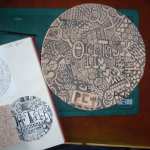
I am on Easter break now and the work over the past two weeks has been in the sketchbooks and have been about not doing the project. Exhaustion, a need for a break, not being near the kiln have become subjects for the work. I biscuit fired five blanks during the last week of term to take home and paint with underglaze colours. I was looking for a subject and, after a lot of drifting about and doodling, I came up with the idea of the doodle as a subject. Today I have spent working on two ‘Off Task’ plates. The first one is close to the original sketchbook images. I wanted something that looked like an exercise book covered in drawings. I wanted the image to be what pupils do when they are off task. The off task of the holiday produces a plate made whilst being on task about being off task.

The other plate I painted some underglaze colours on and let them dry in patches. I picked up a Taschen book called ‘Art Now’, looking for an image of that sort of doodle abstraction like Lasker or the Taaffe or Rae. It didn’t have any but I started a drawing based on Ofili and then I was off, looking through the book and doodling around the artists. So it is a mash up of references to really Now art. The idea of it looking like a the doodles of a well informed pupil on their exercise book was sort of the intention. That was the idea anyway.

I know none of these are doodles. I am referencing the idea of doodles or automatic writing, trying to make images of a state of mental drift during the holidays. The driven and obsessive nature of the work at school in grabbed moments is part of the rhythm of school life and of fitting in an art practice around the teaching practice or having the art practice infect the teaching or the teaching infiltrate the art practice. As you like. So I have been trying to make something about the release of that tension and the tiredness of the holidays.

People often say to me that it must be nice to have the long holidays and that it must be nice to get to paint. In fact I tend not to. I tend to spend the holidays lying down in a bit of a slough of despond wondering where all of my energy went. Last week I spent reading ‘The Crimson Petal and the White’ by Michel Faber which is a fabulous book and well hit the spot, being immersed in Victorian London for a week. But not art and not the project. You need a break from all of this though.

Continuing to make plates as quickly as I can as the end of term looms. In twelve weeks time the kiln will be taken off me, the school will close and the project, or this phase of it, will be over and I will be in the writing up phase. This is my chance to make as much work as I can and to explore the ideas of the project as thoroughly as I can through the making of work.

I have become obsessed to a degree with the making of plates. I have often thought that this was one of the things that the artist teacher should be modelling in the classroom – obsession. Not an easy thing to prescribe or encourage and it has a potentially negative connotation. But as far as art is concerned how else does a big pile of sunflower paintings get done or a whale skeleton covered in graphite markings if not by obsession? Perhaps there’s a better word I should use.

One of the things I am showing in the classroom here is extreme focus and enthusiasm for a narrow range of ideas. I am clearly working my way through something at the back of the classroom. I have delegated the rolling out of clay to Shirley, my technician. I have got year seven involved in the making of sprigs. This afternoon we made plastecine name plates and I poured my fourth big mould with them. There was also a couple of plastic toys, some lego and a toy car under there. After Easter we will be having a go at making these into plates.

Today I worked on a big plate in one of the three moulds I am now using. I made a new one from an Oxfam plate and I have a broken bowl one we bought. Today I was using a camera mould that I made a couple of weeks ago. I poured one half of it and then David Sturman suggested that I make a slip mould of it so I completely encased the camera. I put off taking it apart but in the event it came apart quite easily so today I used the front half as a press mould for the first time.

I was setting off to make the plate I had decided on some time ago to commemorate the carrying of a sketchbook and a camera since the age of fourteen but I got distracted. Shirley has been clearing out the cupboards with me in readiness for the end of days at Gisleham and she found some perspex relief images of plugs that I made with year eight at Kirkley Middle School many years ago. These things were ground out with a computer controlled milling machine in Great Yarmouth when sending some control files through the email was an innovative activity. I had been the only art teacher on a DT project and had made a ‘stained glass’ window about plugs as part of a Pop Art project.

I tried to get an impression off these perspex plates and ended up using vegetable oil as a release agent to get the clay off. This worked quite well. Then I started on the flexible rubber prints from some long lost science lab that I sometimes print from. These are left over from the days before photocopies and are a rubber relief print on a flexible metal base. Presumably these fitted into some printing machine for duplication back in the Fifties. I got a couple of good impressions off of a heart diagram and a fly, again using the veg oil as a release.

So the circumstances and the finding of things had distracted me from my initial aim and had led me astray. The plate was going to be called A History of Art and it still is that, only in a different way to the original idea i sketched. It has an archaeological feel to it and it still is a history of art. The original intention has not been abandoned and it is still buried in the plate. It is less obvious though. Interesting effect. The central tile is based on a recently rediscovered woodcut from the Artpost years of mail and postal art.

Biting the clay custard cream was a mistake though.

It has been an interesting few days.

Today I was flying something of a fantasy to myself about how you might explain the appeal of sprig moulds in ceramics to children. I was inventing a whole series of connections around the idea of one of my moulds of a custard cream that appear on my plates.

I decided that the main things are the transformational possibilities of casting things into clay, the possibility of making patterns and the return of things in the work, like 3D printing.
And I was thinking of the transformational aspects, the transforming of a biscuit into a memorial of itself, of the clay biscuit lasting into the future far longer than any biscuit could, transmogrified by art. Of people looking at this clay biscuit in many years to come and speculating on the exact nature of the object, long since mouldered into mush.

And so on. When I got to school I was working on a tester plate on a plastic picnic plate that I could use with the kids as a mould and I tried out a biscuit sprig mould. This time I painted some black slip into the mould and then pressed the red clay in. It came out as black biscuit, both comic and sad and an instant little memorial that I stuck on the plate.

Had I preloaded my unconscious to do that by my flight of fancy over a mortal biscuit? I hadn’t really planned it that way directly. It just came out like that. When I looked at the biscuit on the plate looking like a tiny monument to biscuits I remembered what I had been thinking about on the way in. Very odd thing.

In the end the children I didn’t need much of an explanation. I made three moulds in front of year seven this morning and an audience of my technician who had rolled out the clay, David who collects Lowestoft Porcelain and helps me out, Carlos and the deputy head who had dropped in on another matter. I took a cast off an old camera someone had given me, a made sprig and tried to make a plate mould off a plate from Oxfam. I talked to the children about what they might make a sprig of for their commemorative plates.

Carefully made ceramic plate with sprigs and slip.

When the going gets tough the tough make a plate.

After the show at NUCA last week of twelve of my plates I have been working on the next set. This one has come together over the past couple of days and deploys my fruit gum sprig moulds. I have had the idea floating about in my head for a while to use these moulds to make a border but I hadn’t got so far as to imagine the central image. I worked on the robot figures and the fruit gums last night after school and I put down a layer of black slip and left it to gently dry over night. This morning I put on two layers of white slip and started to draw an image based on a sketchbook drawing, engraving into the damp slip.

I elaborated the simple sketch into something much more complex during the course of the day, working on it during lunchtime and whilst the year sevens were quietly getting on.

At the end of the day a lad came over and started to watch me at work on the plate as I was finishing off the border area. ‘Just watching’ he said. Which was fine. After a while a couple of girls came over and I had a little crowd gather.

‘Who is it supposed to be?’ asked the lad.

‘It’s Mr Cope. You can tell.’ said a girl.

‘But he hasn’t got a beard.’

‘It’s him when he was younger.’ she said.

‘What’s that rectangle round him?’

‘He’s looking into a mirror and seeing himself as he was when he was younger, isn’t he? And the sweets and the toys are because it’s about when he was young.’ explains the girl. I am obviously very pleased about this exchange as one pupil explains my work to another.

The drawing is based on a recollection of a drawing I was always sentimentally attached to. It was a self portrait in a vest that I drew when I was about fourteen. It was the first thing I remember doing when the drawing looked back at me with a certain amount of style and the start of the Cope line. It was expressive, as I remember and the first drawing that I did that was.

I lost it of course. God knows where it went. Out with my Action Man and Lego bricks I should think. But my question here is have I lost it? When I can recreate a memory of it on a plate. Can you lose anything that is in your head?

Even if you want to.

An interesting day.