
We went over to Fen Ditton to see Laurence’s new paintings of bird nests that he has made since moving into a new studio at the old Fire Station in Saxmundham. Laurence told us that he had collected nests when he was tidying hedges and so on and when tidying up he realised that he had a collection of seven or eight of them. He became fascinated by them and decided that he wanted to study them, to closely examine them. the way that the nests are made in different ways by different species and how they reflect the environment by being made with different materials depending on their locale His sculpture was exploring constructions with wood and twigs and he didn’t want to construct nests as such. Apparently nests are one of the few things that humans cannot replicate in construction. So Laurence decided to make oil paintings for the first time since school. Every morning he would spend an hour making paintings from the nests and the show at Lynne Strover’s Gallery is the first public showing of them alongside Maggi Hambling in a show called ‘Exchange’. They are really nice paintings, they have are really interesting quality to them. They don’t seem to be at all worried about what they are doing.
Images from a visit to the MAA in Cambridge. Very interesting museum with the upper galleries still exuding the charm and atmosphere of the old dark wooden cabinets and slightly wonky displays whilst downstairs it is all fresh and new with metal duck egg blue cabinets. If the whole place is ‘upgraded’ then a sense of the history of the collection and a lot of atmosphere will be lost in the process. At the same time one can see that a liking for Edwardian display cases may be a minority interest and that they are rather dark and dusty, possibly not up to current curatorial and conservation standards. A difficult one.
I was very taken with the Nigerian wooden masks which are very wonderful and the superb ‘Janus’ mask. An attendant got me a chair when she saw I was going to try to draw it. A great Y7 project ready to go. The masks were accompanied by some fantastic black and white photographs of a band a dancers in the Nigerian village in 1912 actually wearing the masks which really made them come alive.

>Wooden frame with antelope skin drawn across it. The black face faces forwards and represents Father Heaven and the hello face represents Mother Earth. From the Cross River area of Nigeria and collected in 1917.
>
>
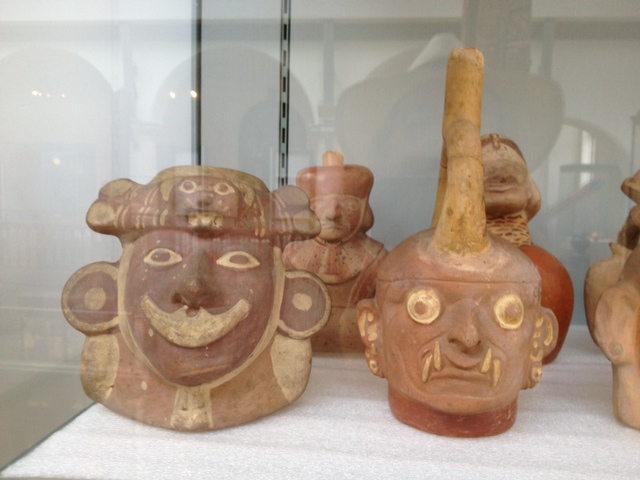
Peruvian pots
>
>
>
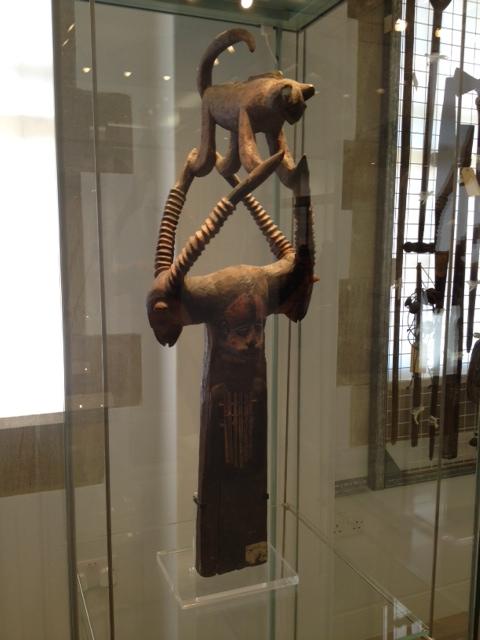
A thumb piano from Kenya.
>
>
>


Drawings in pen and pencil in the notebook.
David and Jane’s in Starston to talk about printmaking, the old days and Peter Iden and view their latest work in idyllic surroundings.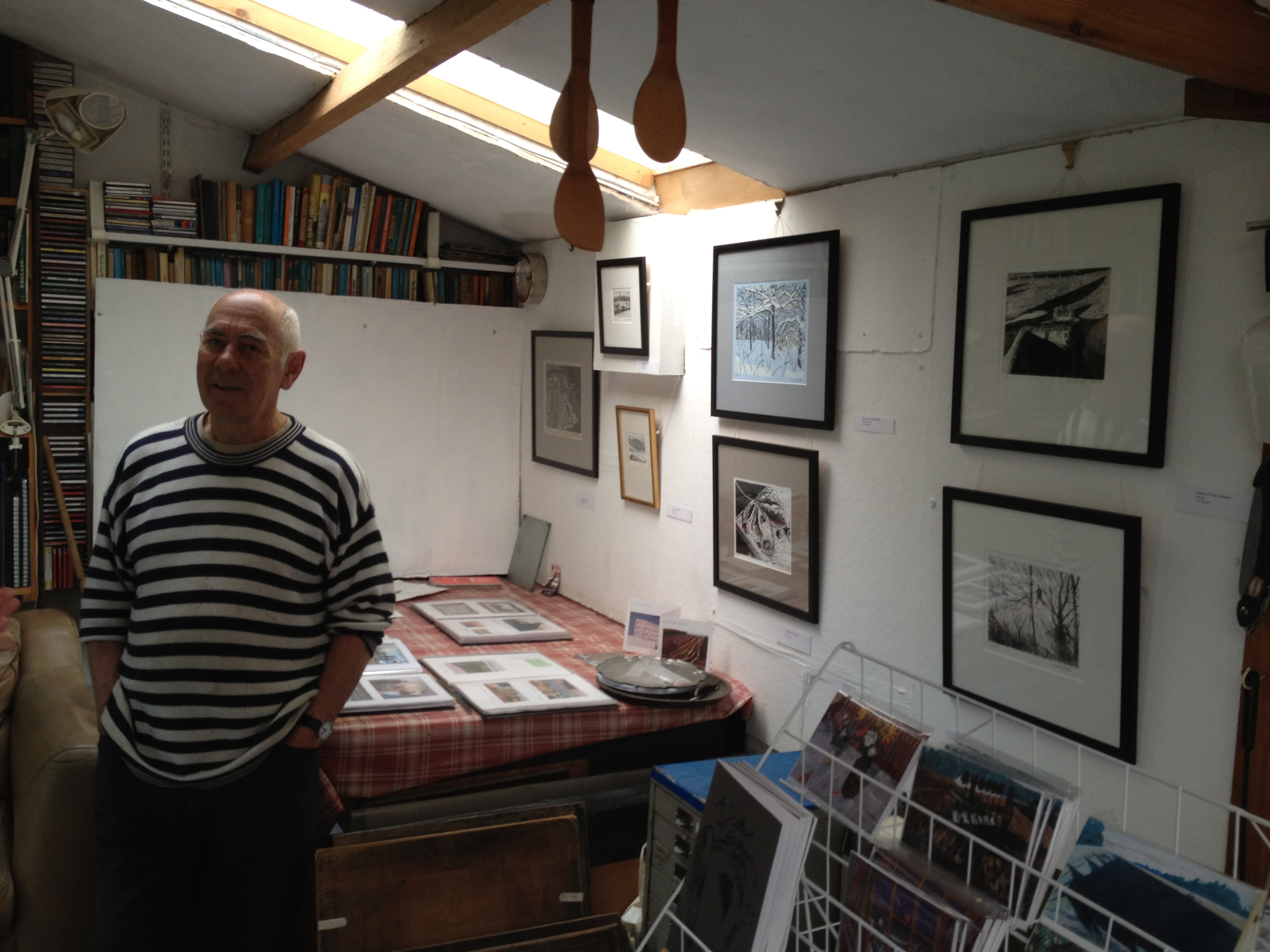
The intention is to demonstrate the making of an art work that is more than a preparatory sketch but possibly less than the dreaded ‘final outcome’. Perhaps the word is a ‘study’. The idea is to use the various stencils that I have cut whilst working with the year ten graffitti inspired students in a fairly free form way along with ideas derived from Kusama at Tate Modern and some of the Mexican grafftti artists in Street Sketchbook. Keri Smith and her work on exploring the world, collage and her sources are also supposed to be in there too. The intention is to demonstrate the synthesis of sources and influences along with a direct approach, without the working up of a preparatory sketch.
1. The art room is running out of large paper. Remembering one of the instructions from the wreck this book/Keri Smith work take what you can find and glue and tape it together to make a surface to suit. The surface itself is thus a collage using things that come to hand. Joing together with glue, parcel tape and some sticky backed plastic. Referencing Rauschenberg’s surfaces etc.
2. Smear some red and acrylic across the surface with a big brush to give yourself something to work on after lunch.
3. Have lunch.
4. Gather the year tens round the table and show them the taped together sheets and explain what I am going to do and why. Set them off on their work programmes for the afternoon. Cut out some little heads from the gold sticky backed plastic (factory throw out) and stick them on. Use two of the head stencils to put on a couple of head shapes looking towards each other so that they are ‘in conversation’. The stencils are nice because they are personal and graphic but they are less personal than the brush mark. They make a sort of tool kit to make an image and I have made them so that they can be put on top of each other to make multi-layered and coloured images.
5. Work over all of the paintings with the stencils to make crowds and a conversation. ‘Finish off’ one of them with a broken brush and a drawing loosely derived from the sketchbook drawings going in between the stencils and collage heads.
Concerning the Coldstream Report – The existing Art Educational System – Text – 60s – STUART BRISLEY
Concerning the Coldstream Report – The existing Art Educational System – Text – 60s – STUART BRISLEY.
An archive of material from 1968 about the Coldstream Report.
I have worked in a lot of art rooms over the years but by far my favourite was the one at GMS. The old Victorian one with the high ceilings and vast windows would be second. I had a lot of fun in that one and largely learnt how to be an art teacher in it but I wasn’t there long. At GMS I had time to sort it out just how I wanted it to be.
It had glass down one side and a view across the playing fields to the tennis courts. It was on the ground floor for ease of access and handily next to the DT room for the borrowing of kit and use of large saws and so on. It was also handy for the dining room. Staff room and offices were just over the hall though it could be a little cut off and sometimes noisy with basketballs bouncing against the wall. I got used to it and it stopped bothering me after about five years.
The room had a kiln in it that I got very fond of. We had to install a fan on top of the school to vent the fumes and this was a massively over engineered piece of kit that sucked paper off the floor two rooms away. I made a lot of plates and huge piles of ceramics with the pupils over the ten years I was there.
There were two sinks and three cupboards in the room and another one just outside in the corridor. I could accommodate a class of pupils with 50x60cm paper and a set of paints and still have room for palettes on the table. And still there was a table along the back wall where I could work, demonstrate things and use a computer. I had a smart board at the front and display boards and shelves around three walls. In the far corner stood the sculpture made by Laurence Edwards for many years. I did a huge amount of work with the pupils whilst I was there and we made a lot of stuff. We had artists in residence in and made work that was shown in galleries nearby and at the art college in Norwich.
We had to pack the room up at the end and on the final day of the school’s existence the kiln was taken out and Laurence came and took away his sculpture. It was a traumatic day and I am still getting over it in many ways.
This written in response to a Keri Smith exhortation to write about your favourite room.
We are still playing around with triggers, starters and instructions at school and in my notebooks and sketchbooks. I am thinking that this could be applied in reverse too and that much of art history could be reverse engineered to their ‘simple triggers’.
Draw your sexual partner in the nude. Draw a stranger in the nude. Draw yourself in the nude. Draw yourself with an injury. Draw your chair. Draw the room. Draw dinner. Draw your idea of God. Draw your boss. Make a figure out of bronze/clay/wood/things that come to hand/floppy things and so on and so on. We are taking Y11 to Tate Modern in a couple of weeks so it might be fun to do that to everything in there. Then what would happen if your made them into file cards and gave them to the kids. We are going to reconstruct the contents of Tate Modern from these simple instructions children. Let’s see how it goes.
Or we could do it entirely with jelly babies. I think that might be cool. I know someone has made Damien Hirst and his shark with Lego already. Making it to scale would be funny. Tate Modern as a model village or perhaps even the entire London art world rendered as a model village. I love model villages.
I never quite get the instruction ‘draw a stranger in the nude’ i.e. the life room. It has been mentioned at school that there are a couple of people that will come in and ‘do’ a life drawing workshop for a price. How do I just know it will be a bloke and a woman and the woman is going to be the one that strips off? As soon as you try other combos; man strips off and woman stays clothed, two men, two women etc. the idea goes a bit woozy and wants a lie down.
I am still fairly obsessively following instructions, particularly with the 100 journal/sketchbook ideas. I gave away something I loved which was a tin of tomato soup. I drew it first though. I have made diary entries in various ways; flyer, encyclopaedia and in very big letters etc. I like the list of things I have bought and I am on the third week of listing my consumerism.
Amy has started a project with her year ten group using these ideas and they have all got journals and experiment folders and so on. They area also making up their own activities and giving themselves instructions which is obviously a good idea. What Smith lacks is a sense of how you might ‘develop’ the work and that is fine, it isn’t really her point. These books are full of ‘starters’, instigators of something that might become ‘works’. I have obviously been taken with some ideas and I have carried them on into various riffs.
What I haven’t done as yet is make up my own instructions. What has been interesting to me has been that lack of control, that surprise element held in this little envelope of idea tickets glued in the back of the sketchbook. What will Keri have me do today? I have been interested in that receiving of the mantra aspect of the process, that giving in to it. I spend a lot of time inventing things for other people to do in various project ways and I am pretty good at designing that sort of activity. It is a nice holiday from that to have someone else tell me what to do for a bit.
I like the pulling out of the slip of paper and that OMG moment followed by the ‘oh yeah, I know how I could do that’ which is, of course, that little flash of creativity in the moment of the restriction, the criteria. So many founder in a sea of ‘free expression’ which is such a mistake. Creativity needs a constraint to work against. Much more productive.
 Can You Tidy Up Now Please?