Archives for category: Uncategorized

Three days or six lessons of making montages with year eight. We are using Paint Shop Pro 7 which is OK, it works. It is pretty complicated but a lot simpler than Photoshop. I have taken shots of the pupils which we have trimmed out and the intention is to show them how to use layers and effects. The project has got a bit bogged down this year in Facebook browsing which I don’t remember being the case so much last year. We aren’t getting as many printed outcomes as quickly this year. Two groups have printed off.

My examples have become quite Baroque as I have fiddled about with every effect in the box and I have had some fun with the controls on the layers, blending and darkening and using duplicates and so on. The original idea came from a Max Ernst collage and there are some Ernsts in the mix on mine. I dare say I could have used a more contemporary artist. Any suggestions?

So far the Identity project has been much the same as last year but next week I intend to go off piste with some life size paintings, using the space in the old DT room and looking at work directly made on the body.

This farmer worked in the barn when it was a farm.

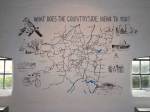
We had the opening of the Culture of the Countryside exhibition at Wingfield Barns this evening. The mural was well received by all. I was particularly pleased that it gained the approval of this gentleman who had actually worked in the barn when it was a farm, many years ago. He was pleased to see that I had got the names of the fields right.

The website was also launched and it features Gisleham Middle School and our part in the project over the last three years in several catagories. And, of course, there is a bit about me.

Half term week so planning a day in the print studio tomorrow. I worked on a plate this afternoon, a plate that has been hanging around since last summer. I made up a big plate that was beyond my technical capabilities and inclination which, as I tend to do, I kept for ‘best’. Which means I will leave it in my will. But, you can’t do that so I used it to make a drawing of shoes outside on the terrace this afternoon. Why shoes? Well, it’s something of a school art room cliche for one. It’s a reference to Van Gogh though somewhat ironic as these shoes are leisure shoes, sports shoes, indeed. They are sitting on a cycling and an art magazine. The idea is that it is part of this set of ‘still life’ drawings of things things that are lying around me in some way. Allegorical personal images in that tradition. I shall dip it tomorrow and print the drawing I made last week of bits and pieces on the table.

The blog has been moribund as I have been preoccupied with the confirmation process at NUCA. I have got through this and I am now officially ‘writing up’. As I approached the confirmation meeting I re-read the 16,000 words that I had produced and realised that it wasn’t quite what I had meant, somehow. It was ever so slightly off my point, rather too much about the artist-teacher. This is pretty well-covered ground and it has been a problem in the research to deal with this, to find an angle on it.

During the meeting I was asked where the practice was in the research and where the researcher had disappeared to. It was all about the teacher bit and the relationship between the artist-teacher and the pupil’s progress. The problem is how do you access the impact of having a teacher make their own work in the classroom through the pupil’s progress. It isn’t very apparent necessarily. It might be more obvious in the sort of work that we do and, I think, some of the brio with which we do it.

The original inspiration for the research had been in looking at the sort of examplars that I made in the classroom to show the pupils what I meant or to show them a particular technique or idea. I have long thought that showing them ‘one I prepared earlier’ was borderline useless as it takes a skilled eye to be able to unpick how an image was actually made. It was more useful to see a piece of work being made before your very eyes and the only way to do that was to actually make work in front of the pupils. Doing this I think about how I learnt how to do something, it made my own learning more apparent to myself and better able to communicate this and the process helped me to anticipate the tricky bits. So, it has been a long standing habit to make work in front of and alongside the pupils. This sort of work though, made as it is with cheapish gouache on sugar paper or 1.99 watercolours on cartridge paper, I didn’t consider to be ‘my work’. I had my own paintings and so on and then I had this utilitarian work I made in class. I didn’t value it as part of my art practice but then again, I nearly always finished the work and I didn’t throw it away either. So I valued it in some way.

I never threw it away because I remember an art teacher showing us how to throw a pot and then knocking it over when he had done and we were shocked and disturbed that he did this. I was about twelve. He said he had lots of pots at home but it still seemed shocking to be able to make something like that but not value the outcome. So I don’t throw them away and I tend to finish them. I give them away sometimes, to adults, not pupils. I let the frost destroy the pots in the garden and I keep the 45 or so self-portraits in the manner of Modigliani amongst the drifts of work in the art room.

So the original interest in the research was, what happens if you take this under valued part of art making, this stream of utilitarian things made to show someone, and make that the art practice. Could it be considered part of an art practice? For a lot of art teachers it is the only art practice they have got. Should we value it more? What is different about making an art work in order to show someone how to do something or to show them an idea? What do they exemplify? Are you making examples for yourself and what might that mean?

We discussed this in the confirmation meeting and we agreed that was probably more interesting than what I had actually written. The nice thing about it is that it puts the practice back into it and stops me having to try to show that my painting a picture two years ago may, or may not, have impacted on a thirteen year old in some ill-defined way.

I have also had a show at NUCA of this sort of work and I will post pictures of this soon. What cam out of this was that everyone seemed to quite like the etchings for their awkwardness and intensity as much as anything. So I am writing this as a plate steeps. One of the 10 x 8 plates that I had before Christmas and that got subsumed in 16,000 academic words. It is based on a photo of myself sitting in the art room as studio that I made for the Artist and their Studio show at SCVA. It is an attempt to use a photo as a basis for a print.

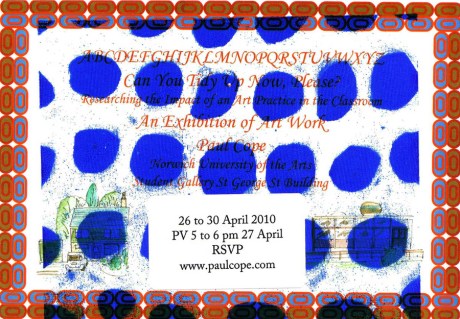
I have been pretty focussed on the confirmation meeting for the PhD which happens tomorrow at NUCA so I haven’t had much time to update the websites. I am also preparing an exhibition at NUCA for the week of the 26th April with the Private View on Tuesday 27th April.

Invite for the NUCA show

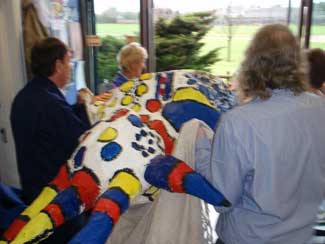
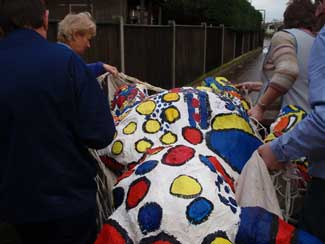
My year 6 class have been a good group to work with, They are the only KS2 group I teach at the moment and they have been roughly shadowing what the other Y6 groups have been doing,with a few extra twists. As part of the Niki De Saint Phalle project we were going to do a 3D piece. The other groups working with non-specialist staff have made papier-mache or brown gummed tape figures. I wanted to make something on a large scale, partly with the Thinking Practice group show at NUCA coming up. I wanted to do it as if I was a visiting artist in for a project to make something spectacular.

I had arm groups, leg groups, a body group, a head group and a horn group. We started building up the basic armature with card and rolled newspaper tubes. We built this up further with a layer or two of brown gummed tape. This works a lot better than traditional papier-mache as it is less prone to going totally soggy and it is a lot easier to clear up. The result is not quite so tough or as smooth as the real stuff but it works quite well.

When it came to putting together the parts that it became apparent that I had badly miscalculated the size of the thing and there was no way it was ever going to go in any car in the car park. The day was saved by Mrs Lewis who had got rather involved in the making of the thing. She told me her son is a builder and has a lorry that we could borrow. Mrs Lewis had got involved because one of her charges had become very interested in the plaster bandage that we put on to strengthen the sculpture. She and a small crack team had spent most lunchtimes working on building the sculpture up. In the end we took Henrietta as she was christened up to Norwich in the lorry and carried her up the stairs in an old football net.

Since the show she has been suspended inside the school along with some of the accompanying paintings, a sort of Phalle ‘skin’ and some of the smaller Phalle sculptures made by the other year six gropus.

As part of the self portrait project this term the Y8 made paintings based on the work of Chuck Close. I admire the artist immensely but as a doing thing it isn’t really me. My painting tailed off badly when the photo got wrecked and I had to start again with a new photo and obviously I didn’t get the lines in the right place so it went well off. The children generally stuck to the idea of transferring the image square by square and we discussed the idea of the squares showing in the final image and so on. Some of the children let the squares show and some went for a more all over effect. Some forgot the photo completely, I think. A very successful display and very popular in the school.

Chuck Close Display

Chuck Close Display

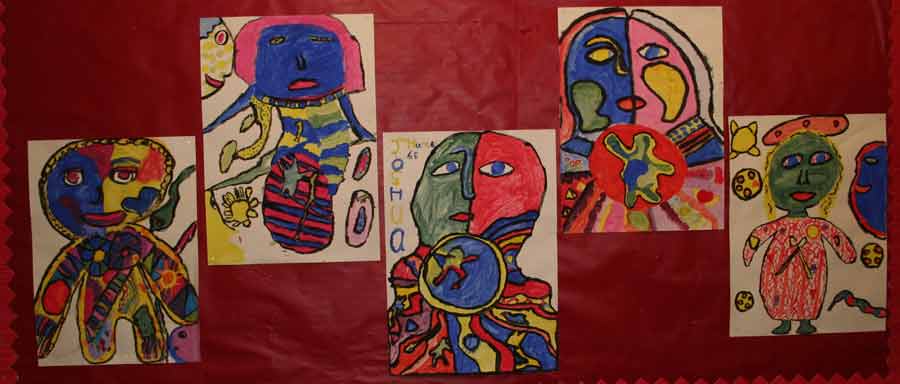
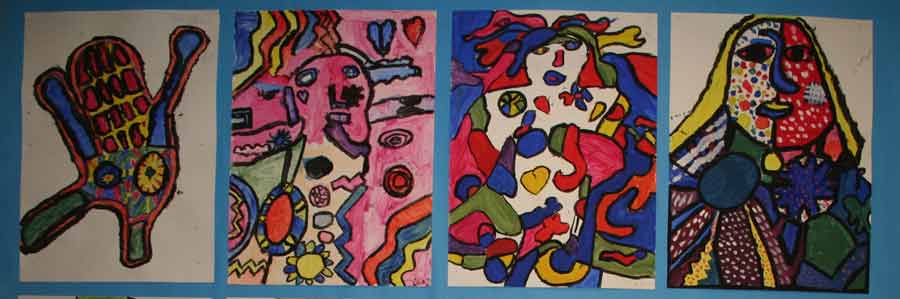
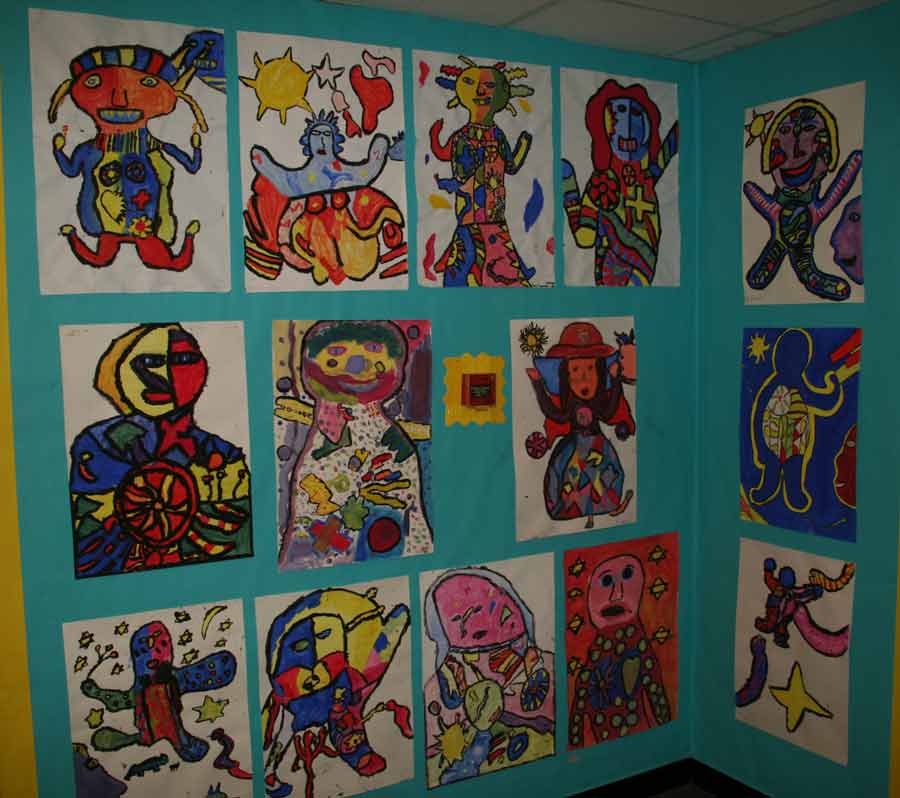
The year six paintings based on or inspired by or using similar means to Niki De Saint Phalle have been finished and have been put up around the school. Everyone seemed to like the colours but there hasn’t been a great deal of feedback as yet. They are OK. Their schema comes through the influence quite nicely or is enhanced by the influence. There is a reasonable amount of ‘play’ in the idea, a reasonable amount of invention and variation within the idea. The black lines can be a bit heavy with some but that would be expected really. The pictures are about A2 and done with Specialist Crafts poster paint.

In other news the Chuck Close paintings with year 8 have been chugging along. We are coming to the end of the project, slowly. The paintings are interesting, highly varied considering they are ‘just’ copying a photograph. Anyway, I’ve started them off on a project for next term which is based on ‘A Sense of Place’. Corny, corny title I know but the idea is that they can do anything they like about a place that has some meaning to them or to change the school in one way. So it covers, potentially, anything from landscape painting to Goldsworthy and Long and so on. Or not. We shall see. So far the homeworks that I have seen have been Sisley, Kandinsky and that chap on Skyarts who does the anamorphic chalk drawings on the floor. They have to find an artist they are interested in, some images of a place that means something to them and have some idea of what they would like to seond their time doing next term.

Photos of the show at the Cut, well, the Gisleham part of it anyway.

This is a year six project, mainly interesting because it went wrong. My MFL colleague who also teaches some art wanted to do a cross-curricular link in her art lessons and wanted to do a French artist. I directed her away from the post-impressionists towards someone a bit more recent and we settled on Saint Phalle. The work is a bit wobbly which can be a boon or a curse but should work well with the younger children, ten year olds in this case. And there is a nice generative sense to the work which is something I use a lot really. I tend to avoid the two years on one painting type of artist, the worriers and fretters, and go for the fecund sort. After all I am trying to get people to generate work rather than worry about it.

Anyway, long story but I end up doing the first part of the project and go for the graphics so that my colleague can do the 3D papier mache bit later when she comes back. With the first group I go for the black outline and get them to paint a black outline to be filled in later. This does not work very well and I rethink for the next group I work with.

It doesn’t work well because the children find it difficult to do the detail and pattern with a brush straight away, because I do an example based on one of the slides with one eye on the head and this means they copy this rather than the other ideas. And Halloween casts a baleful influence. So I end up with a whole load of Saint Phalle monsters rather than dancing ladies and it all goes rather wrong.

With the next group I pencil the lines and get them to paint the primary colours and simple mixes in first with a view to putting a thin black line on later. These all work much better. My example I base more on this image and this means I get more like this but no monsters. All more or less humanoid.

I have three examples on the go. One is a self-portrait (ish), one I do for my wife and finish it during a lunchtime for her (the original is called The Couple) and the one I did with the first group I radically remodel this morning by cutting out the head and putting a proper female face instead. So I remodel the lesson and redirect the children by remodelling my model. This makes a difference and though I have now got a group with black paint outlines, new starts and various types of colouring in the results are much better.