Archives for category: Demonstrations

The thing with the learning journals is that they remain, for me, rather obstinately books. I know the theory that what you write on makes a difference to what and how you write and I agree. It does make a difference. So does the pen or pencil or brush which is why I am such an avid customer of cultpens. But I tend to write and draw on anything that comes to hand and then glue it into a traditional sketchbook. Part of me thinks this is efficient and straight forward. Book technology has lasted so well for good reason. It works amazingly well. Simple, robust, satisfying, water-resistant, battery free. Etc. Trying to reinvent the book with some less effective version doesn’t appeal. But I am very aware that the book is also something of a strait jacket with it’s tediously rectangular pages and chronology implied by order and  leaf turning.

Why can I not make a book that isn’t a book? My new bookbinding skills have enlarged my book vocabulary into some interesting multi-paper books. I have made a couple of these now. They have pages of as many different papers as I can find including graph paper, drafting paper, various sorts of maths paper and so on. These have been designated ‘off task’ books and they are being worked on with variations on automatism, the marks relating to the paper and the showing through of the image before and the dots and lines and so on. Non-chronological and undated. Filled in as I go along whilst watching telly or in idle moments. Trying to break habits of finishing everything and making things match and keeping inside a genre and all that sort of thing.

Still books though.

Today I had some time at school on my own in the classroom because of the strike day. I tidied stuff up and started collecting card ready for the learning journals module. I thought it would be an idea to make a book out of some matt grey board I found so I cut it to size at 15cm square. My intention was to make a book of some sort and, having cut the card, I looked at the pile of it and thought about how to bind it with big rings or string or elastic and so on. It would still be a book though so then I started thinking about a box. In the end I settled on a slipcase design and I found a small CD and drew round that to make the finger hole so that I could get the card out of the box. I used the hot glue gun to stick it together because I like the rough edges it gives, like welding joins on cardboard. Everyone else thinks it looks rough as hell though so I tired to finesse the edges and failed pretty much so I decided to paint it white with a view to it being an undercoat. My intention was for it to be a sort of painting book and to carry the separate bits of card around and mark them up and then put them in the box.

But at some point my decision making changed. I picked up the small size CD that I had used to cut the finger space on the edges of the box and I drew round it on a piece of the card to ‘start things off’, to get the first card in the box with a mark on. This looked quite good. It was more or less in the middle and it looked good, the way a circle int he middle of a square does. So I did another one. And I painted that with the white acrylic. And i did another one. Then I painted a few squares roughly with ahite to get going and to be the background for a circle.

Whilst these dried I got on with a bit more tidying and found some old art magazines and an art history part work and I picked up a full sized CD and started cutting round that on the magazines and sticking them on the card. Then using the holes I had cut as stencils on the card and then sticking down the holes with the paint around the edges from the stencilling and sticking smaller circles n top of the bigger circles and so on. I was basically riffing on circles and collage and white paint and a black drawing pen. The rules of the game changed slightly as each new element came along, as I found something else to collage on or a new relationship between the paint, the cut outs, the holes and the simple marks.

Then a colleague needed some input on monoprinting so we spent an hour making monoprints of various sorts together and I did them as circles with a view to collaging them on. By the end of the day I had thoroughly distracted myself from the various things I should have been doing but I had pretty nearly completed a series of circles on a square riffs. 31 cards mostly marked on both sides. I think they should be called ’62 studies’ or something like that. It is a teaching aid, of course, a demonstration piece for the learning journals modules of a non linear book. It is also an example of a flow of connected creativity, one thing leading to another. Clearly thought about as I did them but quite quickly done and not easily annotated at the time.

Must make another one when I get back from Oxford.


Spent the day at the NUCA drawing workshop with Sarah making books. I just could not get my head around how you sew the signatures together. A number of helpful diagrams have swum before my eyes recently. I cut the signatures at home and I was all ready to go. Once Sarah had shown me what to do I was away, more or less. I made one A4 sketchbook with a pretty wildly bright blue wipe clean cover, an orange ribbon and some flower wrapping paper from Paperchase as end papers. It looks pretty good. Whilst that was drying I sewed 15 signatures of varied paper together to make a random A5 book. I glued on the scrim when I got home.

The idea was to make a couple of demonstrations of hand made learning journals for the summer school; the ultimately customised learning journal. What would it be like of the whole book was randomly papered with graph paper, cartridge and dotted paper and so on? Difficult to make an A4 book like that though I could have a go at a pretty random book with the varied papers we have lying around at school. Would that affect what you did in the book? Would this affect how you feel about the book?

I tried not to be too precious about it all. I can see that one could get carried away with it and then never want to actually make a mark in the beautifully crafted object. My two today were pretty rough really. Look OK from a distance and once they are full of collage and cuttings and photos they should look good. The random one I want to draw in straight away and I haven’t put the boards on yet.

How about making a book in leaves and then binding it together later? Sarah suggested a Japanese side stitch technique.

We also discussed gold leafing a plate. I have some not real gold leaf from Great Art but I realise that I don’t have much clue on how to use it. I want to make a gold leaf plate.

Is making art and distraction or a concentration? Is it both? Is obsessively making art in the circumstances I find myself in at school (which aren’t nice, it has to be said. Closure of school in seven weeks.) distracting myself from the main event here or am I doing the right thing? I did catch myself wondering that and it slowed me up for a while. It all looked a bit cracked.

Today it looks sort of incredible and sort of all right. I am preparing for a job interview tomorrow and there isn’t much more I can do, certainly not at school. There were four rolled out plates in the moulds form Friday when I hadn’t been able to finish anything off at all. I have been asked to put some work into a little charity show nearby and I thought one of the main project weird plates might not do so I toyed with a De Waal pottery book last night and the idea of making some Decoratively Abstract ones. I liked the plates by Katsue Ibata in the book I did a drawing of it in the sketchbook. I made a version of this on the first plate and then another one. Then I copied a drawing of a gas mask that I did in the Norwich Regimental Museum last Thursday onto another one and then did a bad style mouse saying ‘Hit Me in the Face’, a message of frustration from The Social Network. And I finished off with big Japanese style mark making with an overlay of a roughly done blue border in the manner of the Lowestoft porcelain teapot that David had proudly shown me on Friday.

Whilst the plates look odd what and the meanings are pretty impacted into them what I like about them is the range of reference going on here. The themes of childhood fascination from the gas mask drawing, the interest in mark making in the Japanese potter’s work, the childish drawing style in the mouse cartoon and the final mash up of Japanese marks and restrained decoration. Highly satisfactory. Very briskly done during lunchtime and in odd moments this afternoon when the children were doing their study drawings for their Stepping Stone project.

Emptied the kiln too and a couple of failures and some disappointments. The heavily oxided ones didn’t fuse on as I had thought. And one of them had failed completely.

The most complicated outcomes have been the two plates that catastrophically failed in the kiln. I was just rushing the firing process and the plates hadn’t thoroughly dried through, evidently. They were two good plates I had made on a Friday afternoon in the art room, after school mainly, one of which experimented with symmetry, almost. To make it worse I printed out a couple of good photographs with the intention of possibly considering a replica and when I showed people they said, ‘wow, they were great’ which just made me feel worse.

It does bring them into the category of Lost Artwork along with all of the others, known and unknown. I mourn them but haven’t got round to replicating them. I could do. The photos are clear and I could and then they would be in the category of replica art works, known and unknown. I like that idea but things have moved on, I have cast new moulds, found new things in the cupboard to press into the clay and so on. Latest thing is a woodcut from the Far East found at the back of a cupboard. This has been fun with slip painted on it and banged into the clay, sprinkled with oxide.

What made the getting out of the broken plates with a brush and dustpan more painful was that I had made three plates which were supposed to look as if they were toying with destruction or their own demise. Sprinkled with raw oxides and dripped with poured slips and so on. These were supposed to look like they were close to falling apart but obviously not fall apart. These were responding to seeing some work in the Halesworth Gallery that uses artfully placed raw materials by Kyle Kirkpatrick, a concert of a late Beethoven quartet at Snape and the news of a family bereavement.

I haven’t fired these yet. I have got anxious about firing and I am leaving the plates a lot longer to dry out. There are fourteen raw plates waiting for a biscuit fire. Mostly sprig based accumulations, termed Art Room Excavations. Thats what they are based on; finding things around the classroom and in the cupboards and pressing it onto plates. They are supposed to look archeological objects.

Not much time to work on any plates today due to other commitments and having to administer maths test which took me out of the art room. I did have time to work on a ‘mind map’ of ideas about how one becomes an art teacher whilst the children sweated over their tests.

Or how this art teacher became one anyway. One of the themes in the work, quite a difficult theme to get across really, is the blind alley, the inappropriate model, the lack of a mentor, the poor advice that can have quite an effect on ones progress through all of this. There are so many people who have very fixed ideas about what they mean about ‘standards’ and ‘skills’ in art that their advice can have a deleterious effect on the young artist. Not to mention the ‘common sense’ views of art that plague one as one is growing up and that are still heard with amazing regularity, in Lowestoft anyway.

It is a testament to the ineffectiveness of decades of art teaching that so many people still hold the view that it ain’t a proper picture if you can’t tell what it is. This is in contrast to the millions who pack Tate Modern and the whole idea of building galleries in godforsaken towns to magically regenerate them. Is this generational? Or is it class based?

But, whatever the ins and outs of all that is, the main point as far as this is concerned is the act of making the maps of influences and tracks of progress or not. Learning journeys tend to be presented as an onward march of progress towards whatever happy, sunny upland the learner currently views the world from but that isn’t the case at all. Well, not for this learner. We are talking here about years of wasted time making paintings that were no use to anyone. Unsold and unloved things. One of the problems students have with the notion of the ‘reflective learner’ is negotiating with the idea that their honest reflections are assessment suicide if they own up to not getting it.

Thinking about ‘not getting it’ or not being told what it was to get and so on made me think more about the people who had been there along the way and I start thinking there’s a plate in that and another one in that. What is a plate about Roger Dean going to look like? Pretty far out, I should think. That wouldn’t have occurred to me without the mapping exercise. The process excavates ideas.

The kiln cooled down this morning and Shirley got a set of plates out. They looked pretty good. I’ll photograph them all tomorrow.

Carlos came in today and spent the day printmaking for his exhibition at the Halesworth Gallery later in the year. He pointed out to me that my having him work in the room and showing him printing techniques is also part of the life of the room. Which it is. Carlos is an architect form Peru, married to a friend and colleague, and making his way in Suffolk. Today we were trying to make a screen print work.

I also worked on three plates today. One crank plate had been in three bin bags since before Easter but was still workable and I finished that off with further sprigs, impressed pattern and some carefully rubbed on green slip along raised surfaces which brought out some of the writing and textures on the biscuits very well. I also made Ray Johnson rabbit plate with green slip. The year sevens I worked with this morning made mail art cards to send to Leiston Middle and I made a couple of demonstrations cards so Ray Johnson has come round again. I didn’t quite finish it but it will have ‘Add to and Return to Mr Cope’ carved into it tomorrow.

I also worked on a blank at home this evening. Another ‘Off Task’ plate. Productive doodling about. .

An afternoon away from the hurly burly of school and being head of year eight. Relatively peaceful. I worked on two plates. One the still life that I printed last week of the Day of the Dead classroom and other bits and pieces. I put another layer of ground on it to rework it further. I also dipped the self portrait print that I had worked on in the classroom when the pupils had been working on their self portraits in their sketchbooks.

I had this brilliant idea to use up a lot of paint and the large card that is under a table at the back of the art room. We were all going to do a self portrait project based on Gormley and Quinn and drawing round ourselves and so on. The idea was that the outline was drawn directly from the body rather than being a depiction in the way that Gormley’s things are directly from him. That was my link anyway in formulating the idea. I thought of Klein and death masks and all sorts as I developed the idea. The first groups on Monday were under enthusiastic though and I gave up the presentation after the yawning and gazing out of the window got on my nerves and we drew a self portrait in our books instead. On Tuesday and Wednesday the groups were more positive and they quite enjoyed themselves with the large scale work and the message will have got round to the Monday groups, probably. Anyway, when the first groups were working in their sketchbooks I modelled concentration and observation and drew out a self portrait on a plate I had ready in the cupboard.

In the workshop I dipped it for a relatively restrained 50 minutes and printed from that. The result is OK – sketchy and relatively under worked compared to most of them. I intend to leave it at that and move on to another one.

Self portrait etching drawn from life Monday 4th October in school.

Looking through the sketchbook I can see that the Whiteread show has had an effect. I was varnishing some collagraphs and ended up varnishing some pages in the book and using scraps of spoilt paper as collage. I found some isometric paper on the desk and started using it to draw on as does Whiteread. I drew some improbable structures in idle moments, enjoying the puzzle like way they come together if you can keep using the isometric framework logically. I could see that the drawings might appeal to the sort of kid who is interested in drawing a s technical thing. I can remember being fascinated by the wonder of perspective and spending hours drawing street scenes and girders coming towards me and rockets going away from me and all that. I was always interested in the minutiae of learning to draw and illusionism is part of being ‘good at drawing’. When you are a kid is it much more? There is a sub-section of ‘being good at cartoons’ I guess. As I drew these improbable forms I realised they looked a lot like the drawings I did some years ago as part of a project based on plugs. All these things looping around and coming back to earlier ideas and connecting to the work of other artists and to learning to draw. I can see these insignificant drawings having these connections to learning to draw, inspired by Whiteread to pick up this isometric paper, linking back to an earlier body of work about plugs which I did with pupils and in my own work, and these link to Whiteread’s switch drawings which I had been unaware of. Complicated. And easily forgotten.
And in a couple of weeks I will have moved on to another mild obsession and these pages stained with the influence of Whiteread will be forgotten. It seems difficult to concentrate on anything for any length of time. This seems to be a feature of the work and the research. I have always been a bit like that any way. Discursive would be kind. Easily distracted more like it. This has helped me be a decent art teacher as my interests and influences are quite wide and I am technically versatile. But the downside is that my work flits about from one idea to another. This isn’t helped by the way it is produced within and around a timetable of hours, fitted into broken up days. We don’t let the kids get really focussed on something for a day or two and we don’t allow ourselves to either as we live these oddly fragmented days. I am beginning to realise that the project is an in depth look at work produced in fragments and I am beginning to see that the work can be left as fragments, left as unfinished ideas or partly done. The big self portrait painting I did as part of the Clemente week hasn’t been touched now for a fortnight or so. The last thing I did was put a bit of shellac into an eye. I don’t think it is going to get any further than it is and I think that is OK. It is what it is. I think that if I go over it or work on it more then I will be working on it with a feeling and interest which has moved on to something else.

Camera

Collagraph camera

On the way to the art college this lunchtime I picked up a hitch-hiker near Beccles. We started talking about hitching, as is traditional and how no one picks anyone up any more. I said I used to hitch all over and told him about hitching across Europe and spending a winter in Israel when I was nineteen. I hitched across France, into Spain, picked grapes, went across Switzerland, the north of Italy and then across the middle of Yugoslavia to Greece, picked olives on Crete and then flew to Israel and worked on a moshav in the Negev for two months. I had then given it up and gone home, rarely leaving the UK since, deciding I wasn’t very good at it.  He asked me how I had found that I talked about the militaristic atmosphere and the Uzi on the tractor and so on. I said that I had found Jerusalem very interesting, in the way that the different religions that have disputed the city over the centuries have done this through architecture, building on top of each others sacred sites and, more subtly, in the way of each others sacred sites. This seemed to show an attention to detail and a degree of respect held for each others religious views, in a way.

I then apologised for talking about religion straight away and hoped that I hadn’t offended him in any way, as they say one shouldn’t talk about religion or politics. Oh, I am interested in people’s take on it, he said, I don’t believe, I used to be a Marxist. How do you mean, you used to be one? I said. And he told me about being ‘heavily shepherded’ in the SWP in Sheffield in the early eighties. He said the stories of the knock on the door at two in the morning to check that you hadn’t strayed from the path was probably mythical but that you were held to account and sometimes given a bad time. It had been hard work and he had got fed up with it and had decided that he was just too petite bourgeoisie for it all.

Ah, I said, that was always my problem but once I realised that I was actually petite bourgeoisie and that there wasn’t much I could do about it, that was my class background, and that people like me go to art college and do the things they do because they are petite bourgeoisie and that this is probably not a bad thing, in the great scheme of things, then I learnt to relax about it. I said that the petite bourgeoisie were a much maligned and under-rated class which was actually quite dynamic and creative as they negotiated their aspirations between the two classes they didn’t quite belong to. We agreed that the petite bourgeoisie could be quite anarchic, which was why the hard left never liked them and, as we were both teachers, where would the teaching profession be without the petite bourgeoisie.

My background is one of crafts people really. One gran was a seamstress making samples in a dress factory in Leicester and taught me to sew. My grandad was a joiner. The other gran worked in a knicker factory for fifty years. Both sets of grandparents lived in council houses all of their lives. One set lived in a prefab for forty years. My Dad was a photographer and worked in industry, as a high street wedding photographer and latterly as the chief photo technician at DeMontfort University. Fay Godwin considered him the best ‘record’ photographer she had met. Most of his cousins became teachers of various sorts.

So today’s image of a camera made as a collagraph connects to something from all of that. It is also my camera du jour, a toughened Olympus, the perfect art room camera, shrugging off drops and paint and clay. A key research tool. I was trying out some of the plastic circuit board backing we found in the DT room and I used PVA wood glue and corundum to make the image. I only had time to pull two prints and there was some tearing of the paper which we thought might have been from the PVA glue losing interest. Ernst gave me some shellac to try instead of the button polish I had used and I will try a couple more coats. I had been worried that the plastic sheet wouldn’t hold the glue so I was perhaps partly right. An interesting image though. Very dark and I liked the speckles across it which came from stray specks of corundum being moved about and trapped in the layer of varnish. So I was trialling a material for possible collagraphs with the pupils and demonstrating the technique, making an example and making a work for the still-life sequence here.

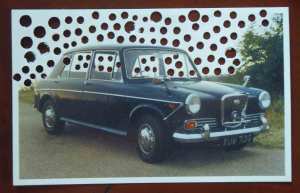
Car

Postcard after Whiteread.

Sort of beginning to think about settling into the new term. It may take a while. The school is in its final year of operation and is in a state of being run down. We only have three year groups in now, there has been no new entry of the younger pupils into the school. They have been retained by the junior schools and are being taught in mobile classrooms on the playgrounds. It is something of a mess in many ways and the future of the new high school in Lowestoft remains problematic. I could describe in detail the process of dismantlement but really the only important things are what is pertinent to the research project.

I was working today on some bits and pieces in the classroom, playing with materials and objects discarded from the the old DT room which is being closed up at the moment. I spent some time improving a postcard found at the back of a cupboard with some hole punches in the manner of Rachel Whiteread whose drawing show I saw at the Tate a week or so ago. I liked the work a lot and I was touched by her casts of the insides of boots which are a lot like the casts of shoes and bags I have on a shelf left over from a year eight girls interest in the artist some years ago. I didn’t know Whiteread cast boots but it seemed an entry level thing for a thirteen year old to cast so I was pleased to see these casts in the display of her studio objects which are a lot like the casts of my old shoes and a handbag on my shelf.

The atmosphere of the work is a lot like the DT room though. It is being emptied out and the traces of fifty years of it being a wood-work and metal-work room and then a CDT and then Dt room are being expunged. The remains of the wood store and some of the tools will be the basis for what I have decided to call the sculpture studio for this last year. The younger children will not get the chance to have the Mr Cope year eight experience because the school will be shut so I intend to give them some taste of the fairly ambitious work I attempt with the older children. Having said that I made the big Niki De Sant Phalle figure with ten year olds last year so there is no reason why they shouldn’t be capable. With the additional storage and building space though I should be able to make more than one figure at a time. And of course I have all that stuff in the cupboards that might be interesting to use one day, collected over the years, and now only a school year to do something with it.

Whitereads on the shelf at school

An afternoon spent in the print workshop devoted to the study and meaning of the edges of etchings.

I mainly like etchings, as much as I like them at all, because they are the remnant of a natural process of acid acting on metal, resisted by some sort of ground. If one wants to get all alchemical about it all then it is possible to be with all the talk of Dutch mordant and tree resin and bitumen and so on. I don’t find that particularly attractive myself, mainly due to the health threatening nature of many of the ingredients. However, the interest lies on the making of an image through the control of a natural chemical process of acids acting on metals. For me the nature of this process needs to be seen in the image so for me the edges of the plate are left as they are after the dipping and biting. This leaves them with a nice raggedy edge. I file them down before I start the process so I don’t cut myself on the metal but once it comes out of the acid I leave them as they are. I wipe them off when I print but the prints end up with a bit of a rough frame of ink from this bitten edge. This partly arises because of the way we back the plates with parcel tape rather than painting on a backing and using an edging paint to protect the edge which we could do. Apparently the real way to finish an etching is to ground down the edge to a 45 degree angle and then polish it with 600 grade wet and dry paper.

Nobody has looked at my beautifully framed etchings and said OMG, look at the edges on that and, as I say, I have reasons for leaving them. What I don’t like about etching is that some of it is about an etiquette of making and selling prints and less about the process as a way of making an art work. I enjoy the Chapman brothers playful attitude to the making of etchings using this fairly quaint process because it is a quaint process. I realised, however that, if I am to be able to say that I have learnt to etch then I need to be able to have the choice of making a well groomed print so I asked Ernst to show me how.

The filing and sanding is tedious but my first prints were disappointingly similar to my previous efforts. I had only done half of the process it would appear and Ernst showed me how to wipe off the edges properly and use the French chalk to seal the edge. This resulted in a more conventional and acceptable result though, to my eye, not necessarily better.

I know it drives Ernst up the pole that I don’t really want to be a fine printer and seem happy to bumble about at a level of relative lack of refinement. I seem happiest for the prints to be a form of drawing more than anything else and I am interested in them at that level. In some ways though, the prints have become less of an expanded form than my work before. I used to be happiest mono-printing  and using that sort of mark making in paintings and with other media. Now these prints have shrunk to tiny eight by ten inch squares of intense combat with the process.

Well, I can do an edge properly now anyway. Whether I will or not I am not sure.

Edge-2

My usual edge showing the acid bitten inked edge of the plate.

Edge01

The edge of the plate after clipping, filing down and then sanding. Edge wiped with a cloth and French chalk to seal the edge.