Archives for category: Ceramics

Todays obsession was very thin clay. I stapled some cloth to a sheet of plywood and this helped as it stops the cloth lifting and wrapping round the rolling pin. Then rolling between two piece of cloth worked even better.

The reason for this was my attempt to make an applique style plate with ‘Well Done Tracey” written on it. Writing reports at school and Tracey deserves one for her best efforts at the Hayward, as I was reading in the Guardian yesterday. This could go on. Good effort, Damien. Could try harder, Marc. Nice work, Dinos. And bits and pieces like that.

Also an almost symmetrical sprig plate and I packed the kiln up. One fell apart as I put it in so I carried on putting it in, in bits with a view to firing it and then trying to join the bits up later with glaze or even araldite.

The most complicated outcomes have been the two plates that catastrophically failed in the kiln. I was just rushing the firing process and the plates hadn’t thoroughly dried through, evidently. They were two good plates I had made on a Friday afternoon in the art room, after school mainly, one of which experimented with symmetry, almost. To make it worse I printed out a couple of good photographs with the intention of possibly considering a replica and when I showed people they said, ‘wow, they were great’ which just made me feel worse.

It does bring them into the category of Lost Artwork along with all of the others, known and unknown. I mourn them but haven’t got round to replicating them. I could do. The photos are clear and I could and then they would be in the category of replica art works, known and unknown. I like that idea but things have moved on, I have cast new moulds, found new things in the cupboard to press into the clay and so on. Latest thing is a woodcut from the Far East found at the back of a cupboard. This has been fun with slip painted on it and banged into the clay, sprinkled with oxide.

What made the getting out of the broken plates with a brush and dustpan more painful was that I had made three plates which were supposed to look as if they were toying with destruction or their own demise. Sprinkled with raw oxides and dripped with poured slips and so on. These were supposed to look like they were close to falling apart but obviously not fall apart. These were responding to seeing some work in the Halesworth Gallery that uses artfully placed raw materials by Kyle Kirkpatrick, a concert of a late Beethoven quartet at Snape and the news of a family bereavement.

I haven’t fired these yet. I have got anxious about firing and I am leaving the plates a lot longer to dry out. There are fourteen raw plates waiting for a biscuit fire. Mostly sprig based accumulations, termed Art Room Excavations. Thats what they are based on; finding things around the classroom and in the cupboards and pressing it onto plates. They are supposed to look archeological objects.

One of the problems that students have with reflective writing is to decide on relevance and disclosure. What information is relevant? What should be included? How wide does one draw the circle around the project? How much do you need to tell?

As we live in difficult times and some of that must impact on the work somewhere then do I have to write up notes on Bin Laden or Clegg? The background buzz of history going about its business, rearranging the zeitgeist. I can’t say I’ve made a plate about that as yet.

The last few days have been difficult and odd and that probably has impacted on the plates so that does need to be written about, in some way.

Not much time to work on any plates today due to other commitments and having to administer maths test which took me out of the art room. I did have time to work on a ‘mind map’ of ideas about how one becomes an art teacher whilst the children sweated over their tests.

Or how this art teacher became one anyway. One of the themes in the work, quite a difficult theme to get across really, is the blind alley, the inappropriate model, the lack of a mentor, the poor advice that can have quite an effect on ones progress through all of this. There are so many people who have very fixed ideas about what they mean about ‘standards’ and ‘skills’ in art that their advice can have a deleterious effect on the young artist. Not to mention the ‘common sense’ views of art that plague one as one is growing up and that are still heard with amazing regularity, in Lowestoft anyway.

It is a testament to the ineffectiveness of decades of art teaching that so many people still hold the view that it ain’t a proper picture if you can’t tell what it is. This is in contrast to the millions who pack Tate Modern and the whole idea of building galleries in godforsaken towns to magically regenerate them. Is this generational? Or is it class based?

But, whatever the ins and outs of all that is, the main point as far as this is concerned is the act of making the maps of influences and tracks of progress or not. Learning journeys tend to be presented as an onward march of progress towards whatever happy, sunny upland the learner currently views the world from but that isn’t the case at all. Well, not for this learner. We are talking here about years of wasted time making paintings that were no use to anyone. Unsold and unloved things. One of the problems students have with the notion of the ‘reflective learner’ is negotiating with the idea that their honest reflections are assessment suicide if they own up to not getting it.

Thinking about ‘not getting it’ or not being told what it was to get and so on made me think more about the people who had been there along the way and I start thinking there’s a plate in that and another one in that. What is a plate about Roger Dean going to look like? Pretty far out, I should think. That wouldn’t have occurred to me without the mapping exercise. The process excavates ideas.

The kiln cooled down this morning and Shirley got a set of plates out. They looked pretty good. I’ll photograph them all tomorrow.

Carlos came in today and spent the day printmaking for his exhibition at the Halesworth Gallery later in the year. He pointed out to me that my having him work in the room and showing him printing techniques is also part of the life of the room. Which it is. Carlos is an architect form Peru, married to a friend and colleague, and making his way in Suffolk. Today we were trying to make a screen print work.

I also worked on three plates today. One crank plate had been in three bin bags since before Easter but was still workable and I finished that off with further sprigs, impressed pattern and some carefully rubbed on green slip along raised surfaces which brought out some of the writing and textures on the biscuits very well. I also made Ray Johnson rabbit plate with green slip. The year sevens I worked with this morning made mail art cards to send to Leiston Middle and I made a couple of demonstrations cards so Ray Johnson has come round again. I didn’t quite finish it but it will have ‘Add to and Return to Mr Cope’ carved into it tomorrow.

I also worked on a blank at home this evening. Another ‘Off Task’ plate. Productive doodling about. .


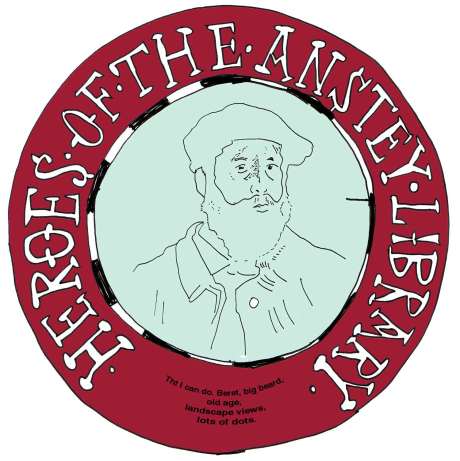
Design for a commemorative plate

Design for a commemorative plate about Monet


I finished another learning journal or sketchbook yesterday in a sudden rush of glued in drawings from the British Museum. I did have a notebook with me which sometimes serves as a sketchbook but I also had a pocket full of postcards and I drew on these instead with a fountain pen. I should have taken some shots of the cards as a pile as it was quite nice to have this pack of shufflable ‘culture cards’ as it were. What I actually did was paste them into the current sketchbook along with other bits and pieces and some photo thumbnails that I had taken with a digital camera. I used this book at school when I was explaining to the pupils how we were going to design our commemorative plates.

I was using my plates, my current practice, as the instigator for the project so I was trying to share with them the inspiration behind my “Admiral Keppel” style plates of a doughty head of art on a sinking ship. As I did so I was thinking about how much the work that I did last summer on the learning journal module for ARU has affected the books. They are packed with huge amounts of detail, much improved referencing and layers of complexity. What I am trying to do is demonstrate something to a future self much more. I am packing up the ideas with a view to unpacking them in the future. I am using the book as a thought technology in a much clearer way than I was before. They make my old sketchbooks (ordinary ones) look utterly casual, letting the reading of them to pure chance.

I don’t decorate the books much, I don’t embellish them with much more than layers of notes and pointers. Beyond the odd bit of collage here and there I just lay them out with gaps for later notes and in fill. They remain pretty chronological, on the whole. I have had a run of using spiral bound books and quite a lot of glueing in. One of the books has black pages and is written in with silver and white pens as a nod towards the idea of journal as scrapbook.

I don’t know what the children make of them but the books do seem to be a much more deliberate presentation of practice than before.

With the year eights I am demonstrating a set of six plates, one for each group. I picked up on Grayson Perry’s ‘Heroes’ pot which I saw in the V and A a few weeks ago when I was drawing in the ceramic galleries. I had the idea (on the 15th January, according to my book) to do a plate about heroes of the Anstey library: towards a job definition. When I was a lad first getting interested in art and being told by peers and some teachers that ‘you really should be an artist, Paul’ I spent a lot of time getting all of the art books out of the Anstey library. I was a committed reader and I read my way round this little library from 1972 to 1977 a couple of times. I was fond of military history, sci-fi of the more cerebral sort, Orwell, art books, drawing primers (the best being Paul Hogarth’s ‘Creative Pen Drawing’), Huxley, and Alistair MacLean. I did not grow up in a house with a great deal of original art beyond my mother’s amateur oil landscapes. There was a print of a chuckling cavalier on the stairs, a couple of Canaletto prints and a writhing black bronze horse with a snake wrapped round it that gave the shivers.

So I had to come up with a job description myself. There was Graphic Design or Commercial Art which I was a bit too flakey for, really. Rather unbiddable for the commercial world. And then there were the lives of the Great Artists int he black Thames and Hudson volumes. What a great bunch of role models they were too. So my plates are dedicated to six wry art heroes of the Anstey library. I think this was all rather lost on the children who were with me as far as Admiral Keppel but stopped getting the jokes thereafter.

One of the things that came out of the physical process of making these designs was tracing the images. I traced the first one about Gauguin and realised that this simplified my source somewhat and seemed to make the possibility of carving it into clay way more achievable so I grabbed some old drafting paper out of the old DT room and found the old light box and we were away. I got the pupils to trace their pictures of Eric Cantona and Bobby Moore (?) and it all started to look a lot more likely to succeed.

The whole process of inspiration from Perry, Toft, and Keppel, of day dreaming in ceramic museum spaces and letting these ideas mull and intermix on bits of paper in books looks fantastically complex and individual. And a huge amount of work. I have been committed to this for some time, if not obsessed. I have really pursued these avenues of thought with pen in hand and the journals and helped me do it. I am modelling obsession, partly. And now I have turned it into a viable school project. It doesn’t look that self evident at all.

I lie awake at night planning sprig moulds of fruit gums.

After the Christmas and New Year lay off I have got back into making the plates again. I made one last week which is another demonstration plate, showing a range of decorative ideas to help the pupils with their commemorative plates. I have had a lot of fun in libraries and museums following up research ideas and I have learnt a lot about pottery.

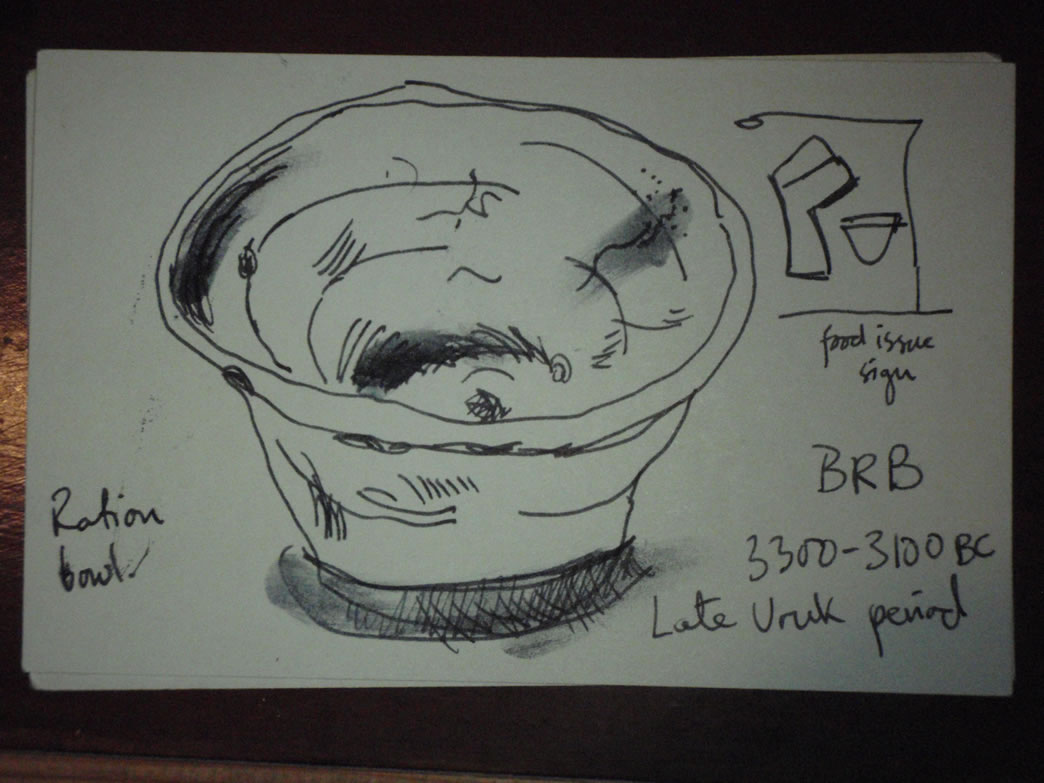
I was in London Friday and after the course finished I made it over to the British Museum for their late night opening. I was particularly after seeing a BRB, a bevelled rimmed bowl from Mesopotamia. I saw these on a BBC programme about the dawn of civilisation. They are apparently so plentiful around Tell Brak that the archeologists have to rebury the things. I made a little drawing of this really very humble object which is symbolic of a great deal.

It is thought to be a ration bowl because of the standardisation of the the size, pressed into a standard mould as they are. This implies that one group of people were being rationed by another group of people, that there were workers and overseers already. Social organisation inferred from a pot. Very interesting. I also found tin ware plates and a huge Thomas Toft platter and spent a couple of hours sketching.


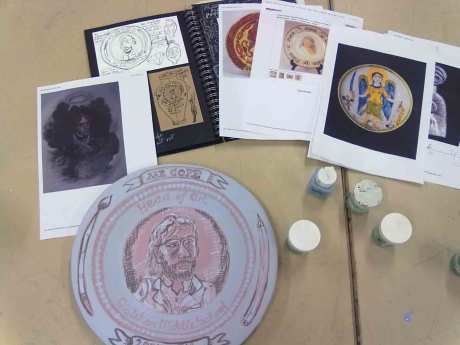
Source material with greenware plate and under glaze.

I had a bit of a gap between school and a meeting about being made redundant so I stayed at school and used the classroom as a studio for an hour or so. I worked on a commemorative plate, channelling Grayson Perry and Gavin Turk with a plate to commemorate my ten years at Gisleham. I used some under glaze on a buff school clay with a couple of layers of blue slip on. I used a few pictures from a google search around commemorative plates in general including a well cheesy one of the queen mum. I based the self portrait on a picture of Nelson (local lad) and this has sent the face a bit off kilter so I might have to rework that a bit.

So before half term I made up a pile of images with the idea of making a ‘dream of Paladino’ piece as a tribute and as a way of thinking about the use of fragments in Paladino’s work. After half term I walked back into the classroom and saw the pile of things on the table and momentarily forgot why I had done it. And then I wondered why I had thought it was a good idea.

After a bit I decided to use them anyway and I quickly put together two ‘Paladinos” which worked quite well. I am not sure what they have to say about fragments though. There is something different about making fragments deliberately to put together into an image. I know what I am doing and I am planning ahead really, I am just building an image out of disparate bits. I make some more fragments on some more varied materials around the art room and make up another one on a small canvas. Not really very happy though. For the research project part of the point is that the different bits of the fragmentary practice are more broken up than that, more separated by time and materials and intention and part of the point is that they only look evenly vaguely coherent after the event. This is different to the bits being made as fragments.

To make a work out of fragments then the work has to be accidentally made as fragments, almost. If that can be done. Certainly I have been thinking more about leaving things undone or half done and not having the same need to ‘finish’ things. But I am not sure how I can deliberately make accidental fragments. Perhaps the point is that all of the work is made of fragments of time and effort and leave it at that.

Is everyone’s? I suppose I am again contrasting this with some sort of Ideal Artist deeply delving into their practice in long lonely uninterrupted hours in the studio as opposed to making stuff in the gaps.

I did a lot of ceramics work with the pupils last week and this and I made a couple of plates up whilst this was going on. I liked these a lot and this has started a chain of thinking about commemorative plates, Grayson Perry, Richard Prince and Lilly Van Stokker and further text pieces in clay.