Archives for category: Art teaching

The most complicated outcomes have been the two plates that catastrophically failed in the kiln. I was just rushing the firing process and the plates hadn’t thoroughly dried through, evidently. They were two good plates I had made on a Friday afternoon in the art room, after school mainly, one of which experimented with symmetry, almost. To make it worse I printed out a couple of good photographs with the intention of possibly considering a replica and when I showed people they said, ‘wow, they were great’ which just made me feel worse.

It does bring them into the category of Lost Artwork along with all of the others, known and unknown. I mourn them but haven’t got round to replicating them. I could do. The photos are clear and I could and then they would be in the category of replica art works, known and unknown. I like that idea but things have moved on, I have cast new moulds, found new things in the cupboard to press into the clay and so on. Latest thing is a woodcut from the Far East found at the back of a cupboard. This has been fun with slip painted on it and banged into the clay, sprinkled with oxide.

What made the getting out of the broken plates with a brush and dustpan more painful was that I had made three plates which were supposed to look as if they were toying with destruction or their own demise. Sprinkled with raw oxides and dripped with poured slips and so on. These were supposed to look like they were close to falling apart but obviously not fall apart. These were responding to seeing some work in the Halesworth Gallery that uses artfully placed raw materials by Kyle Kirkpatrick, a concert of a late Beethoven quartet at Snape and the news of a family bereavement.

I haven’t fired these yet. I have got anxious about firing and I am leaving the plates a lot longer to dry out. There are fourteen raw plates waiting for a biscuit fire. Mostly sprig based accumulations, termed Art Room Excavations. Thats what they are based on; finding things around the classroom and in the cupboards and pressing it onto plates. They are supposed to look archeological objects.

One of the problems that students have with reflective writing is to decide on relevance and disclosure. What information is relevant? What should be included? How wide does one draw the circle around the project? How much do you need to tell?

As we live in difficult times and some of that must impact on the work somewhere then do I have to write up notes on Bin Laden or Clegg? The background buzz of history going about its business, rearranging the zeitgeist. I can’t say I’ve made a plate about that as yet.

The last few days have been difficult and odd and that probably has impacted on the plates so that does need to be written about, in some way.

Carlos came in today and spent the day printmaking for his exhibition at the Halesworth Gallery later in the year. He pointed out to me that my having him work in the room and showing him printing techniques is also part of the life of the room. Which it is. Carlos is an architect form Peru, married to a friend and colleague, and making his way in Suffolk. Today we were trying to make a screen print work.

I also worked on three plates today. One crank plate had been in three bin bags since before Easter but was still workable and I finished that off with further sprigs, impressed pattern and some carefully rubbed on green slip along raised surfaces which brought out some of the writing and textures on the biscuits very well. I also made Ray Johnson rabbit plate with green slip. The year sevens I worked with this morning made mail art cards to send to Leiston Middle and I made a couple of demonstrations cards so Ray Johnson has come round again. I didn’t quite finish it but it will have ‘Add to and Return to Mr Cope’ carved into it tomorrow.

I also worked on a blank at home this evening. Another ‘Off Task’ plate. Productive doodling about. .


Design for a commemorative plate

Design for a commemorative plate about Monet


I finished another learning journal or sketchbook yesterday in a sudden rush of glued in drawings from the British Museum. I did have a notebook with me which sometimes serves as a sketchbook but I also had a pocket full of postcards and I drew on these instead with a fountain pen. I should have taken some shots of the cards as a pile as it was quite nice to have this pack of shufflable ‘culture cards’ as it were. What I actually did was paste them into the current sketchbook along with other bits and pieces and some photo thumbnails that I had taken with a digital camera. I used this book at school when I was explaining to the pupils how we were going to design our commemorative plates.

I was using my plates, my current practice, as the instigator for the project so I was trying to share with them the inspiration behind my “Admiral Keppel” style plates of a doughty head of art on a sinking ship. As I did so I was thinking about how much the work that I did last summer on the learning journal module for ARU has affected the books. They are packed with huge amounts of detail, much improved referencing and layers of complexity. What I am trying to do is demonstrate something to a future self much more. I am packing up the ideas with a view to unpacking them in the future. I am using the book as a thought technology in a much clearer way than I was before. They make my old sketchbooks (ordinary ones) look utterly casual, letting the reading of them to pure chance.

I don’t decorate the books much, I don’t embellish them with much more than layers of notes and pointers. Beyond the odd bit of collage here and there I just lay them out with gaps for later notes and in fill. They remain pretty chronological, on the whole. I have had a run of using spiral bound books and quite a lot of glueing in. One of the books has black pages and is written in with silver and white pens as a nod towards the idea of journal as scrapbook.

I don’t know what the children make of them but the books do seem to be a much more deliberate presentation of practice than before.

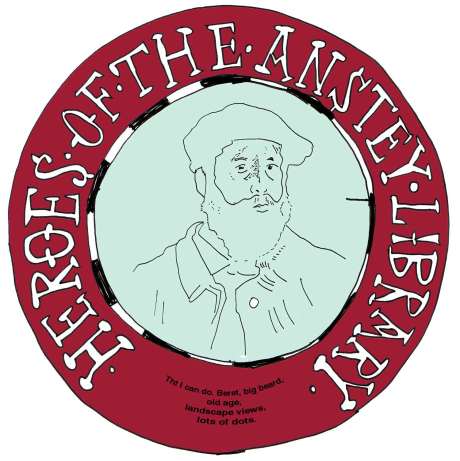
With the year eights I am demonstrating a set of six plates, one for each group. I picked up on Grayson Perry’s ‘Heroes’ pot which I saw in the V and A a few weeks ago when I was drawing in the ceramic galleries. I had the idea (on the 15th January, according to my book) to do a plate about heroes of the Anstey library: towards a job definition. When I was a lad first getting interested in art and being told by peers and some teachers that ‘you really should be an artist, Paul’ I spent a lot of time getting all of the art books out of the Anstey library. I was a committed reader and I read my way round this little library from 1972 to 1977 a couple of times. I was fond of military history, sci-fi of the more cerebral sort, Orwell, art books, drawing primers (the best being Paul Hogarth’s ‘Creative Pen Drawing’), Huxley, and Alistair MacLean. I did not grow up in a house with a great deal of original art beyond my mother’s amateur oil landscapes. There was a print of a chuckling cavalier on the stairs, a couple of Canaletto prints and a writhing black bronze horse with a snake wrapped round it that gave the shivers.

So I had to come up with a job description myself. There was Graphic Design or Commercial Art which I was a bit too flakey for, really. Rather unbiddable for the commercial world. And then there were the lives of the Great Artists int he black Thames and Hudson volumes. What a great bunch of role models they were too. So my plates are dedicated to six wry art heroes of the Anstey library. I think this was all rather lost on the children who were with me as far as Admiral Keppel but stopped getting the jokes thereafter.

One of the things that came out of the physical process of making these designs was tracing the images. I traced the first one about Gauguin and realised that this simplified my source somewhat and seemed to make the possibility of carving it into clay way more achievable so I grabbed some old drafting paper out of the old DT room and found the old light box and we were away. I got the pupils to trace their pictures of Eric Cantona and Bobby Moore (?) and it all started to look a lot more likely to succeed.

The whole process of inspiration from Perry, Toft, and Keppel, of day dreaming in ceramic museum spaces and letting these ideas mull and intermix on bits of paper in books looks fantastically complex and individual. And a huge amount of work. I have been committed to this for some time, if not obsessed. I have really pursued these avenues of thought with pen in hand and the journals and helped me do it. I am modelling obsession, partly. And now I have turned it into a viable school project. It doesn’t look that self evident at all.

I lie awake at night planning sprig moulds of fruit gums.

So before half term I made up a pile of images with the idea of making a ‘dream of Paladino’ piece as a tribute and as a way of thinking about the use of fragments in Paladino’s work. After half term I walked back into the classroom and saw the pile of things on the table and momentarily forgot why I had done it. And then I wondered why I had thought it was a good idea.

After a bit I decided to use them anyway and I quickly put together two ‘Paladinos” which worked quite well. I am not sure what they have to say about fragments though. There is something different about making fragments deliberately to put together into an image. I know what I am doing and I am planning ahead really, I am just building an image out of disparate bits. I make some more fragments on some more varied materials around the art room and make up another one on a small canvas. Not really very happy though. For the research project part of the point is that the different bits of the fragmentary practice are more broken up than that, more separated by time and materials and intention and part of the point is that they only look evenly vaguely coherent after the event. This is different to the bits being made as fragments.

To make a work out of fragments then the work has to be accidentally made as fragments, almost. If that can be done. Certainly I have been thinking more about leaving things undone or half done and not having the same need to ‘finish’ things. But I am not sure how I can deliberately make accidental fragments. Perhaps the point is that all of the work is made of fragments of time and effort and leave it at that.

Is everyone’s? I suppose I am again contrasting this with some sort of Ideal Artist deeply delving into their practice in long lonely uninterrupted hours in the studio as opposed to making stuff in the gaps.

I did a lot of ceramics work with the pupils last week and this and I made a couple of plates up whilst this was going on. I liked these a lot and this has started a chain of thinking about commemorative plates, Grayson Perry, Richard Prince and Lilly Van Stokker and further text pieces in clay.

Introduction

The original inspiration for the research came from looking at the examplars I made in the classroom to show the pupils a particular technique or idea. I have long thought that showing them ‘one I prepared earlier’ was not very useful as it takes a skilled eye to be able to unpick how an image or object was actually made. It is more useful to see a piece of work being made before your very eyes and so I actually make work in front of the pupils. Whilst doing this, I think about the ways in which I learn to do something; it makes my own learning more apparent and I am then better able to communicate this and the process helps me to anticipate the tricky bits. So, it has been a long-standing habit to make work in front of and alongside the pupils. This sort of work though, made as it is with cheapish gouache on sugar paper or £1.99 watercolours on cartridge paper, I didn’t consider to be ‘my work’. I had my own paintings and other work and then I had this utilitarian work I made in class. I didn’t value it as part of my art practice but then again, I nearly always finished the work and didn’t throw it away either. So I valued it in some way.

I never threw it away because I remember when I was twelve, an art teacher showing us how to throw a pot, then knocking it over when he had done. We were shocked and disturbed that he did this. He said he had lots of pots at home but it still seemed shocking to be able to make something as well as he had but not value the outcome. So I don’t throw them away and I tend to finish them. I give them away sometimes, to adults, not pupils. I let the frost destroy the pots in the garden and I keep the forty-five or so self-portraits in the manner of Modigliani amongst the drifts of work in the art room.

Part of why I value them is because they often have a looseness and freedom that my more considered work doesn’t have. Some of the paintings, made with cheap paints, have a quality that work with acrylics on canvas or board don’t have and I am fascinated by this aspect. Making work in front of thirty children can be less inhibited than work made alone in a studio. I am concentrating very hard on demonstrating the idea and the decisions about why I am doing it have been made at a much earlier stage. I also become very practised at making the particular pieces as I am likely to do the same demonstration four or five times in a. I might not make a mono-print based on a drawing from the Sainsbury Centre again for a year but for that week I become very focused on that particular method. The demonstration is more of a live performance than a studio recording, with more energy in a short space of time and different production values.

Part of what I am doing is modelling the project and giving the children a target but I am also validating their work by showing that it was worth an adult doing it too. I also finish the work for fun, for pleasure and because I am practising making art. I am still running through the learning exercises of being an artist like a musician practising scales. Though now I have set the exercises partly out of a consideration of what I wish I had known about art when I was their age. Anecdotally, art teachers have told me that they have collections of work made in this way. They have not considered these as their ‘own work’ either and we have discussed the possibility of making an exhibition of these ‘lost’ works.

This research project is a subsection of the interest in the artist teacher and much of the initial research was guided by the literature on various artist teacher projects thus far. The development of this interest in the demonstration as a form of art practice is a response to a the lack of detail in the current research about the effect that the art practice of the art teacher can be said to have in the classroom. This project proposes that all art teachers who make demonstrations in the classroom are carrying out a form of art practice. An examination of this neglected or lost aspect of teaching and art practice is the original contribution to knowledge.

The research question, therefore, is ‘Can the classroom art demonstration be recontextualised as an art practice?’

The research process is based in case studies about working in the classroom with pupils aged between nine and thirteen in a middle school. The art practice is inspired by the teaching and learning process in the classroom and vice versa. The work considers the role of skill in art, of learning to draw, the nature of what is demonstrated and learnt in art lessons and the notion of influence as an educational tool.

The art and teaching practice is conditioned by the restraints of the school curriculum. The art practice has been guided by the school projects. The artwork allows the different influences and projects in the classroom to wash through it, trying on multiple artist’s practices. The demonstrations in the classroom have become the whole of the art practice and work made beyond the classroom is seen as a demonstration. What the artist is demonstrating and to whom becomes part of the work. The artist is demonstrating his or her own work to themselves in the studio as well as the classroom. The art practice examines what it is that is being demonstrated and what that might say about the relationship between the artwork and audience.

Case Studies

The research is centred on five case studies. Four of these are based in the classroom and examine different projects over a period of three school terms. Three of these projects use an orthodox teaching method, using the work of an artist as a starting point. One was based on Alan Davie and Sandra Blow, one used camouflage as a theme and the third, called How to Paint and Draw, was based on observational and expressive painting and drawing. The fourth project concerns a visiting artist, Craig Kao, to the classroom.

The fifth case study is the art practice of the teacher. This is the major part of the study. The art practice case study covers a range of work over the duration of the project that relates to the teaching practice and shows a development of the practice based on the demonstration in the classroom. The work produced in this fifth case study relates to initial case studies. An analysis of the classroom case studies and what has been discovered from them provides further material for the art practice. Some of the conclusions and outcomes reached in the art practice have fed back into small art projects in the classroom as part of a dialogue between the two practices.

Etching

As part of the research, I learnt how to etch at the art college. This was a way of becoming a learner and putting myself in the position of a pupil acquiring a skill. I had done little etching before, partly because I had not found it a particularly conducive medium and partly because of the technical difficulties involved. It is not of much use in the classroom due to the health and safety issues and I realised that most of the skills I had acquired during my teaching career had come about due to their usefulness in the classroom. In this way my teaching and working in a middle school has conditioned my art practice and guided it in a certain way. Some media and techniques are more applicable than others in the classroom and my skills have been extended in paper-mâché and large-scale cardboard sculpture in a way that they might not have been had I not been a teacher.

The etching process has produced a set of etchings along with writings discussing being a pupil learning a craft skill, the sort of work that has been produced using this skill and how that might relate to contemporary practice, particularly the work of the Chapman brothers and Paula Rego. The etching has fed into the classroom project on Alan Davie and Sandra Blow as some pupils made dry points with a small press and I have shown the etchings to pupils and displayed them at school. The awkwardness of the process and the interest in drawing that the medium has provoked has related to the How to Paint and Draw project.

One theme of the art practice is how one learns about making art and how that learning has informed teaching. My art education and subsequent teacher training, the expectations of the education system and those of the pupils and parents inform what I teach and how. The folklore of art and artists affect what happens and the background that the pupils bring to lessons. The mythologies and common-sense views of art have also affected how I learnt about art and how I went from being ‘good at drawing’ through art college to art teaching and art practice. I have this in common with many art teachers and I see pupils who are ‘good at drawing’ in my classes.

Another theme in the art practice is drawing – notions of good drawing and drawing to acquire the skill of drawing. Drawing manuals and the exercises and clichés of drawing are referenced ironically and are used in the classroom and art practice. I use drawing a lot in the classroom but I use it to express, to map, to imagine and to communicate as much as to observe and analyse. I use a wide range of media to draw including print, computers, paint and clay as well as more traditional pen and pencil. This has meant some arguments with external inspectors expecting evidence of more observed drawing. One of the points against an emphasis on observational drawing skill in the classroom is that it alienates the majority of pupils who find the process difficult and confusing. The intention of a curriculum based on a broad range of artists and media is to try to give as many pupils as possible a positive introduction to making and thinking about art. This is sometimes referred to as inverting the pyramid. This means a project based on colour, collage and Sandra Blow that does not foreground drawing skill will appeal to more pupils than one based on observational drawing skill that values ‘good at drawing’.

Alan Davie and Sandra Blow

This was the idea explored in the classroom project initially based on Alan Davies and the free associative drawing practice he uses to generate ideas and images. We took this as a starting point and then developed imagery through a range of media and techniques including paint, collage, and printmaking. As the project progressed, we looked at other artists such as Sandra Blow whose collages were very popular with the pupils. Alongside this project I made a large number of drawings in the manner of Davie as I developed the project and I made prints and paintings as demonstration pieces in front of the children. I also made three large paintings based on Davies and a series of collages based on Sandra Blow. These have been exhibited at NUCA and in a small show in Suffolk.

An interest in abstract art has been a further theme in the art practice and I have produced a large number of painting studies inspired by Jonathan Lasker and Thomas Nozkowski. This is part of a theme about influence in art and art teaching. The intention is to use the work of an artist as a benign influence in the classroom as a part of modeling or the scaffolding of a learning experience. It is a way to present a historical view of art and to introduce children to the work of artists through the visual. It can serve to introduce a range of voices into the classroom from different times and cultural viewpoints.

Artists have always been influenced by other artists and has been a way to learn about art. Many artists have made work based on or inspired by the work of artists that they admire. Much art is a conversation between artists through art works and this continues into contemporary art. This seems to validate the use of artists in the classroom though it causes some problems with notions about originality and creativity.

I think of the art projects as a series of games with rules in different places. Art can be considered an etiquette, a way of doing things. The use of artists’ work in the classroom introduces children to the idea that art can be made in a wide variety of ways about many things with many materials. This week we are being neat and tidy and staying inside the lines and next week we are splashing plaster bandage around on a large sculpture together. A set of rules allows the pupils to express themselves in a certain way and hopefully think about the work of an artist and acquire some technical insight into a medium or technique.

One of the things that has altered through the project is this methodology. I am experimenting with more tangentially influenced projects where the work of artists has influenced me in the construction of the project and I use the work of artists less. In a way I have expanded my role as an artist in the classroom and used myself more as an interpreter. Previously I have tried to be transparent and present the work of artists in a neutral way. Some of the work I have done with pupils has shown me that my role as interpreter and presenter is considerably more of an influence than the artist I am presenting. When I use the work of an artist in the classroom I bring a l present a synthesis of what I know about the artist and present this in a way that makes it accessible to the pupils. This has led me to think about my role as an art teacher in the classroom and to play with the role of art teacher. Some of the art practice is based around the persona of an art teacher who has become a semi-fictional figure. By stepping outside, questioning and making work about the role, the presentational and performative aspects have become more apparent.

This realization that I am acting as an interpreter comes out of work on the teacher’s voice taken from transcriptions of videos of classroom demonstrations. This voice has become text on paintings and drawings as I explain how the work I am demonstrating is being made. In this way the internal scripts that teachers use become more apparent. A number of works with running commentaries on them have been produced.

Visiting Artist

Questioning the role of the art teacher has also arisen from the fourth classroom case study involving the visiting artist, Craig Kao. Craig was with us for a week as part of a Sainsbury Centre of the Visual Arts project on Culture in the Countryside. We cleared the art room of as much as we could and filled the space with large amounts of found materials. We left the timetable as normal for the week. This was partly to cause as little disruption as possible to the school and to ensure that the maximum number of children would have the experience with Craig. This meant that the artist was obliged to work within the constraints of the teaching structure of a school as a new set of children appeared each hour. Craig obviously found this quite difficult as he was unused to working in this way and has no teacher training.

The week heightened my awareness of my role as a teacher and as an artist as Craig and I worked together on a series of collaborative paintings and sculptures with each other and the children. The results were exhibited at the Cut gallery in Halesworth in October 2009.

The experience made me very aware of the channelling and institutionalising effect of working in a school; how used one becomes to the structures and expectations of the school day. Not that Craig and I really stepped outside them but we moved them around and we did something more unexpected with these strictly allotted hours.

Phalle

This led me to a take a different approach to some projects thereafter, particularly the Nikki De Saint Phalle project that I did with a group of ten year old children. I decided to try to be an artist in residence or an imagined notion of an artist in residence with the project. We set off with paintings and then made a collective sculpture with a cardboard armature and a paper-mâché and plaster bandage skin. I was much more directive as if I was the artist and the group were my assistants. I split the group into teams for each section of the figure and then we put the parts together and plastered it together. We finished off with acrylic paint and we also made a set of studies of the marks for the surface that made a sort of skin of the figure which we exhibited as a large painting. The result was exhibited at NUCA in February 2010 and at the school.

By being my own artist in residence I mean that I foregrounded the artist aspect of the role and tried to imagine being Phalle working with nine year olds to make one of her sculptures. I went into the room more focussed on getting them to make a very large scale figure rather than on constructing lessons with learning objectives. I worked with the resources I had to achieve the artistic result that was more in my mind than theirs. My improvisation resulted in my getting the size quite wrong and the only way we got the piece to Norwich was by borrowing a builder’s lorry to move it. The pupils got a lot out of it despite the lack of formal learning objectives. They came down at lunchtime to put the plaster bandage on and to paint the figure. The project began to step outside the constraints of the lessons and inspired and esprit de corps in the group that still exists when we work together. The project did generate the sort of excitement that an artist in residence project often does.

The rhythms of the school day and the school year have become evident in the work. The fragmentary nature of the work becomes more obvious as ideas are pursued but only so far, conditioned as much by the attention span of the children as by that of the artist. There is never enough time to be thorough, as the curriculum demands a move to cover a new topic or method. The teaching practice conditions the art practice. How the two have become interwoven or mingled together is part of the art work and it becomes difficult to tell what the art practice would look like without the teaching practice.

The art work, some class work and accompanying writing has been catalogued on a blog over the past year at http://www.paulcope.com. The art practice and class work has been exhibited at NUCA, the Cut in Halesworth and at Wingfield Barns as part of the SCVA Culture of the Countryside project over the past year. The work has been extensively recorded through a series of learning journals and sketchbooks and there is an extensive photo archive.

Picasso Improved No. 3

IDuring my art teaching career I have always made art work in the classroom in one way and another. I have always had some element of my own art practice in the classroom, some project on the go at the back of the room or on a desk. I also make work in front of the children as demonstrations of idea, technique or style. How do you show someone how to make a coil pot other than by making one in front of them? When I was first starting art teaching the art adviser told us that we were the best resource in the room, that we were representatives of art practice for the pupils we taught.

I realised over the years that I had accumulated folders of work made in front of children. I tended to finish the work and often worked on them whilst the children were working on theirs. I was modelling the project and giving them a target but I was also validating their work by showing that it was worth an adult doing it too. I also finished them for fun, for pleasure. I remember an art teacher showing us twelve year olds how to make a pot on the wheel and we were all very impressed. At the end of his demonstration he smashed it with his hand. He said that he had enough pots at home and that he didn’t need another one. We were shocked that he could do that to his own work, that he didn’t value his own work to that extent. I resolved never to do that in the classroom.

Because of this I have accumulated a collection of work which is not quite my own art practice but which I value enough not to throw away. Some of this is kept to be examples next time but I tend to make afresh for each project. In my view learners find a finished art work difficult to unravel and to see a piece being constructed has the most value. Anecdotally other art teachers have told me that they have collections of work made in this way. Not considered as their ‘own work’, work made for a pedagogical purpose in the classroom.

My question is can this work be considered as the basis of an art practice? Can this sort of work made for an educational purpose be re-contextualised as art practice? Is this a lost or mislaid art practice at the heart of art teaching practice?

This project is a subsection of the interest in the artist teacher and much of the initial research was guided by the literature on various artist teacher projects thus far. The development of this interest in the demonstration as a form of art practice comes out of a frustration at the lack of detail in the current research about the effect that the art practice of the art teacher can be said to have in the classroom. This project proposes that all art teachers who make demonstrations in the classroom are carrying out a form of art practice.

The project is based on five case studies. Four of these take place in the classroom and the fifth is the art practice case study, intersecting with the classroom ones. Much of the current art practice arises from an analysis of the classroom case studies and an examination of the role of the art teacher’s demonstrations and subsequent art work arising from them.

The art work is inspired by the teaching process, by questions about how we learn about art and the autobiography of learning about art in school and beyond. The art work plays with the persona of an art teacher playing with the styles and tropes of art education in schools. The work considers the role of skill in art, of learning to draw, the nature of what is demonstrated and learnt in art lessons of the notion of influence as an educational tool.

The practice is conditioned by the restraints of the school curriculum. The art work allows the different influences and projects in the classroom wash through it, trying on multiple practices. The demonstrations in the classroom have become the whole of the art practice and work made beyond the classroom is seen as a demonstration. What the artist is demonstrating and to whom becomes part of the work. Is the artist demonstrating their own work to themselves? What is it that is being demonstrated? If it doesn’t look like art then what is it that is being demonstrated?

The rhythms of the school day and the school year become evident in the work. The fragmentary nature of the work becomes more obvious as ideas are pursued but only so far, conditioned as much by the attention span of the children as by that of the artist. There is never enough time to be thorough, as the curriculum demands a move to cover a new topic or method. The teaching practice conditions the art practice. What would the art practice look like without the teaching practice? Have the two become completely interwoven?

An afternoon away from the hurly burly of school and being head of year eight. Relatively peaceful. I worked on two plates. One the still life that I printed last week of the Day of the Dead classroom and other bits and pieces. I put another layer of ground on it to rework it further. I also dipped the self portrait print that I had worked on in the classroom when the pupils had been working on their self portraits in their sketchbooks.

I had this brilliant idea to use up a lot of paint and the large card that is under a table at the back of the art room. We were all going to do a self portrait project based on Gormley and Quinn and drawing round ourselves and so on. The idea was that the outline was drawn directly from the body rather than being a depiction in the way that Gormley’s things are directly from him. That was my link anyway in formulating the idea. I thought of Klein and death masks and all sorts as I developed the idea. The first groups on Monday were under enthusiastic though and I gave up the presentation after the yawning and gazing out of the window got on my nerves and we drew a self portrait in our books instead. On Tuesday and Wednesday the groups were more positive and they quite enjoyed themselves with the large scale work and the message will have got round to the Monday groups, probably. Anyway, when the first groups were working in their sketchbooks I modelled concentration and observation and drew out a self portrait on a plate I had ready in the cupboard.

In the workshop I dipped it for a relatively restrained 50 minutes and printed from that. The result is OK – sketchy and relatively under worked compared to most of them. I intend to leave it at that and move on to another one.

Self portrait etching drawn from life Monday 4th October in school.

Looking through the sketchbook I can see that the Whiteread show has had an effect. I was varnishing some collagraphs and ended up varnishing some pages in the book and using scraps of spoilt paper as collage. I found some isometric paper on the desk and started using it to draw on as does Whiteread. I drew some improbable structures in idle moments, enjoying the puzzle like way they come together if you can keep using the isometric framework logically. I could see that the drawings might appeal to the sort of kid who is interested in drawing a s technical thing. I can remember being fascinated by the wonder of perspective and spending hours drawing street scenes and girders coming towards me and rockets going away from me and all that. I was always interested in the minutiae of learning to draw and illusionism is part of being ‘good at drawing’. When you are a kid is it much more? There is a sub-section of ‘being good at cartoons’ I guess. As I drew these improbable forms I realised they looked a lot like the drawings I did some years ago as part of a project based on plugs. All these things looping around and coming back to earlier ideas and connecting to the work of other artists and to learning to draw. I can see these insignificant drawings having these connections to learning to draw, inspired by Whiteread to pick up this isometric paper, linking back to an earlier body of work about plugs which I did with pupils and in my own work, and these link to Whiteread’s switch drawings which I had been unaware of. Complicated. And easily forgotten.
And in a couple of weeks I will have moved on to another mild obsession and these pages stained with the influence of Whiteread will be forgotten. It seems difficult to concentrate on anything for any length of time. This seems to be a feature of the work and the research. I have always been a bit like that any way. Discursive would be kind. Easily distracted more like it. This has helped me be a decent art teacher as my interests and influences are quite wide and I am technically versatile. But the downside is that my work flits about from one idea to another. This isn’t helped by the way it is produced within and around a timetable of hours, fitted into broken up days. We don’t let the kids get really focussed on something for a day or two and we don’t allow ourselves to either as we live these oddly fragmented days. I am beginning to realise that the project is an in depth look at work produced in fragments and I am beginning to see that the work can be left as fragments, left as unfinished ideas or partly done. The big self portrait painting I did as part of the Clemente week hasn’t been touched now for a fortnight or so. The last thing I did was put a bit of shellac into an eye. I don’t think it is going to get any further than it is and I think that is OK. It is what it is. I think that if I go over it or work on it more then I will be working on it with a feeling and interest which has moved on to something else.

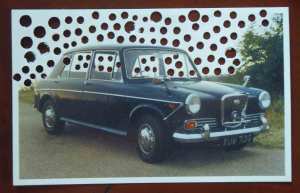
Car

Postcard after Whiteread.

Sort of beginning to think about settling into the new term. It may take a while. The school is in its final year of operation and is in a state of being run down. We only have three year groups in now, there has been no new entry of the younger pupils into the school. They have been retained by the junior schools and are being taught in mobile classrooms on the playgrounds. It is something of a mess in many ways and the future of the new high school in Lowestoft remains problematic. I could describe in detail the process of dismantlement but really the only important things are what is pertinent to the research project.

I was working today on some bits and pieces in the classroom, playing with materials and objects discarded from the the old DT room which is being closed up at the moment. I spent some time improving a postcard found at the back of a cupboard with some hole punches in the manner of Rachel Whiteread whose drawing show I saw at the Tate a week or so ago. I liked the work a lot and I was touched by her casts of the insides of boots which are a lot like the casts of shoes and bags I have on a shelf left over from a year eight girls interest in the artist some years ago. I didn’t know Whiteread cast boots but it seemed an entry level thing for a thirteen year old to cast so I was pleased to see these casts in the display of her studio objects which are a lot like the casts of my old shoes and a handbag on my shelf.

The atmosphere of the work is a lot like the DT room though. It is being emptied out and the traces of fifty years of it being a wood-work and metal-work room and then a CDT and then Dt room are being expunged. The remains of the wood store and some of the tools will be the basis for what I have decided to call the sculpture studio for this last year. The younger children will not get the chance to have the Mr Cope year eight experience because the school will be shut so I intend to give them some taste of the fairly ambitious work I attempt with the older children. Having said that I made the big Niki De Sant Phalle figure with ten year olds last year so there is no reason why they shouldn’t be capable. With the additional storage and building space though I should be able to make more than one figure at a time. And of course I have all that stuff in the cupboards that might be interesting to use one day, collected over the years, and now only a school year to do something with it.

Whitereads on the shelf at school

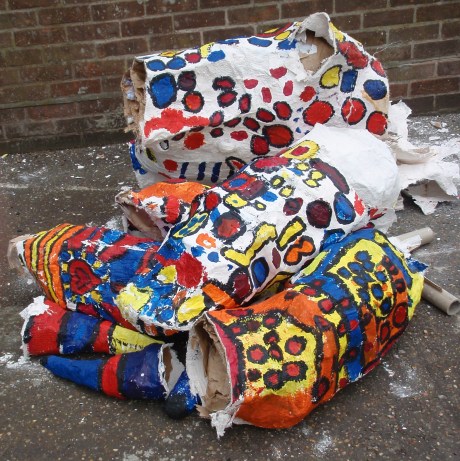
All things must end and sadly Henrietta, our very fine Saint Phalle figure, had to go this week. She has done sterling service in the art college and on display in the covered courtyard at school for over a term but it was time for her to go. We considered putting her top of my garage to the delight of my neighbours no doubt, or taking her on a valedictory tour of Lowestoft in the back of Mrs Lewis’ lorry but in the end we decided she would have to go in the recycling bin. My technical support team have had some fun with this. Henrietta has been replaced with a show of hands.

Henrietta meets her end

A Show of Hands