Picasso Improved No. 3

IDuring my art teaching career I have always made art work in the classroom in one way and another. I have always had some element of my own art practice in the classroom, some project on the go at the back of the room or on a desk. I also make work in front of the children as demonstrations of idea, technique or style. How do you show someone how to make a coil pot other than by making one in front of them? When I was first starting art teaching the art adviser told us that we were the best resource in the room, that we were representatives of art practice for the pupils we taught.

I realised over the years that I had accumulated folders of work made in front of children. I tended to finish the work and often worked on them whilst the children were working on theirs. I was modelling the project and giving them a target but I was also validating their work by showing that it was worth an adult doing it too. I also finished them for fun, for pleasure. I remember an art teacher showing us twelve year olds how to make a pot on the wheel and we were all very impressed. At the end of his demonstration he smashed it with his hand. He said that he had enough pots at home and that he didn’t need another one. We were shocked that he could do that to his own work, that he didn’t value his own work to that extent. I resolved never to do that in the classroom.

Because of this I have accumulated a collection of work which is not quite my own art practice but which I value enough not to throw away. Some of this is kept to be examples next time but I tend to make afresh for each project. In my view learners find a finished art work difficult to unravel and to see a piece being constructed has the most value. Anecdotally other art teachers have told me that they have collections of work made in this way. Not considered as their ‘own work’, work made for a pedagogical purpose in the classroom.

My question is can this work be considered as the basis of an art practice? Can this sort of work made for an educational purpose be re-contextualised as art practice? Is this a lost or mislaid art practice at the heart of art teaching practice?

This project is a subsection of the interest in the artist teacher and much of the initial research was guided by the literature on various artist teacher projects thus far. The development of this interest in the demonstration as a form of art practice comes out of a frustration at the lack of detail in the current research about the effect that the art practice of the art teacher can be said to have in the classroom. This project proposes that all art teachers who make demonstrations in the classroom are carrying out a form of art practice.

The project is based on five case studies. Four of these take place in the classroom and the fifth is the art practice case study, intersecting with the classroom ones. Much of the current art practice arises from an analysis of the classroom case studies and an examination of the role of the art teacher’s demonstrations and subsequent art work arising from them.

The art work is inspired by the teaching process, by questions about how we learn about art and the autobiography of learning about art in school and beyond. The art work plays with the persona of an art teacher playing with the styles and tropes of art education in schools. The work considers the role of skill in art, of learning to draw, the nature of what is demonstrated and learnt in art lessons of the notion of influence as an educational tool.

The practice is conditioned by the restraints of the school curriculum. The art work allows the different influences and projects in the classroom wash through it, trying on multiple practices. The demonstrations in the classroom have become the whole of the art practice and work made beyond the classroom is seen as a demonstration. What the artist is demonstrating and to whom becomes part of the work. Is the artist demonstrating their own work to themselves? What is it that is being demonstrated? If it doesn’t look like art then what is it that is being demonstrated?

The rhythms of the school day and the school year become evident in the work. The fragmentary nature of the work becomes more obvious as ideas are pursued but only so far, conditioned as much by the attention span of the children as by that of the artist. There is never enough time to be thorough, as the curriculum demands a move to cover a new topic or method. The teaching practice conditions the art practice. What would the art practice look like without the teaching practice? Have the two become completely interwoven?

An afternoon away from the hurly burly of school and being head of year eight. Relatively peaceful. I worked on two plates. One the still life that I printed last week of the Day of the Dead classroom and other bits and pieces. I put another layer of ground on it to rework it further. I also dipped the self portrait print that I had worked on in the classroom when the pupils had been working on their self portraits in their sketchbooks.

I had this brilliant idea to use up a lot of paint and the large card that is under a table at the back of the art room. We were all going to do a self portrait project based on Gormley and Quinn and drawing round ourselves and so on. The idea was that the outline was drawn directly from the body rather than being a depiction in the way that Gormley’s things are directly from him. That was my link anyway in formulating the idea. I thought of Klein and death masks and all sorts as I developed the idea. The first groups on Monday were under enthusiastic though and I gave up the presentation after the yawning and gazing out of the window got on my nerves and we drew a self portrait in our books instead. On Tuesday and Wednesday the groups were more positive and they quite enjoyed themselves with the large scale work and the message will have got round to the Monday groups, probably. Anyway, when the first groups were working in their sketchbooks I modelled concentration and observation and drew out a self portrait on a plate I had ready in the cupboard.

In the workshop I dipped it for a relatively restrained 50 minutes and printed from that. The result is OK – sketchy and relatively under worked compared to most of them. I intend to leave it at that and move on to another one.

Self portrait etching drawn from life Monday 4th October in school.

Looking through the sketchbook I can see that the Whiteread show has had an effect. I was varnishing some collagraphs and ended up varnishing some pages in the book and using scraps of spoilt paper as collage. I found some isometric paper on the desk and started using it to draw on as does Whiteread. I drew some improbable structures in idle moments, enjoying the puzzle like way they come together if you can keep using the isometric framework logically. I could see that the drawings might appeal to the sort of kid who is interested in drawing a s technical thing. I can remember being fascinated by the wonder of perspective and spending hours drawing street scenes and girders coming towards me and rockets going away from me and all that. I was always interested in the minutiae of learning to draw and illusionism is part of being ‘good at drawing’. When you are a kid is it much more? There is a sub-section of ‘being good at cartoons’ I guess. As I drew these improbable forms I realised they looked a lot like the drawings I did some years ago as part of a project based on plugs. All these things looping around and coming back to earlier ideas and connecting to the work of other artists and to learning to draw. I can see these insignificant drawings having these connections to learning to draw, inspired by Whiteread to pick up this isometric paper, linking back to an earlier body of work about plugs which I did with pupils and in my own work, and these link to Whiteread’s switch drawings which I had been unaware of. Complicated. And easily forgotten.
And in a couple of weeks I will have moved on to another mild obsession and these pages stained with the influence of Whiteread will be forgotten. It seems difficult to concentrate on anything for any length of time. This seems to be a feature of the work and the research. I have always been a bit like that any way. Discursive would be kind. Easily distracted more like it. This has helped me be a decent art teacher as my interests and influences are quite wide and I am technically versatile. But the downside is that my work flits about from one idea to another. This isn’t helped by the way it is produced within and around a timetable of hours, fitted into broken up days. We don’t let the kids get really focussed on something for a day or two and we don’t allow ourselves to either as we live these oddly fragmented days. I am beginning to realise that the project is an in depth look at work produced in fragments and I am beginning to see that the work can be left as fragments, left as unfinished ideas or partly done. The big self portrait painting I did as part of the Clemente week hasn’t been touched now for a fortnight or so. The last thing I did was put a bit of shellac into an eye. I don’t think it is going to get any further than it is and I think that is OK. It is what it is. I think that if I go over it or work on it more then I will be working on it with a feeling and interest which has moved on to something else.

The Halesworth Gallery has an open show every autumn and I usually contribute something. I am on the committee and have been for the past ten year or so. This is a legacy from when I used to organise art shows in fields and marshes with a friend. In the end I got asked to be on the committees of a couple of art galleries in the town and this has been part of my being active in the local art community. Halesworth Gallery has been there since 1966 in an old alms house in the town. We show from May to September and put on about seven shows a year with a couple of shows of children’s work at the start and the end of the season. And we always have the Open Show.

This year I put in two square pieces which were supposed to be channelling Lily Van Der Stokker . Unfortunately I didn’t get down to Tate St Ives to see the show and they have been tardy in sending me the book but I read about it in magazines and online. I was intrigued by the idea that her work can be seen as being aggressive in its prettiness. I really like it. It appeals to me as it is clearly quite annoying whilst being very ‘nice’.

So I made one piece with water colour on the canvas using a frilly manner of calligraphy. It reads ‘A Painting to Cheer Everyone Up’. The other piece was made with thin acrylic over a layer of clay based house paint. It reads ‘How to Paint and Draw’. This is the title of one of the case studies and it was supposed to sit in the middle of the wall of varied open show type work and be a half question about the work around it. A low key intervention in the show really.

Three days or six lessons of making montages with year eight. We are using Paint Shop Pro 7 which is OK, it works. It is pretty complicated but a lot simpler than Photoshop. I have taken shots of the pupils which we have trimmed out and the intention is to show them how to use layers and effects. The project has got a bit bogged down this year in Facebook browsing which I don’t remember being the case so much last year. We aren’t getting as many printed outcomes as quickly this year. Two groups have printed off.

My examples have become quite Baroque as I have fiddled about with every effect in the box and I have had some fun with the controls on the layers, blending and darkening and using duplicates and so on. The original idea came from a Max Ernst collage and there are some Ernsts in the mix on mine. I dare say I could have used a more contemporary artist. Any suggestions?

So far the Identity project has been much the same as last year but next week I intend to go off piste with some life size paintings, using the space in the old DT room and looking at work directly made on the body.

Camera

Collagraph camera

On the way to the art college this lunchtime I picked up a hitch-hiker near Beccles. We started talking about hitching, as is traditional and how no one picks anyone up any more. I said I used to hitch all over and told him about hitching across Europe and spending a winter in Israel when I was nineteen. I hitched across France, into Spain, picked grapes, went across Switzerland, the north of Italy and then across the middle of Yugoslavia to Greece, picked olives on Crete and then flew to Israel and worked on a moshav in the Negev for two months. I had then given it up and gone home, rarely leaving the UK since, deciding I wasn’t very good at it.  He asked me how I had found that I talked about the militaristic atmosphere and the Uzi on the tractor and so on. I said that I had found Jerusalem very interesting, in the way that the different religions that have disputed the city over the centuries have done this through architecture, building on top of each others sacred sites and, more subtly, in the way of each others sacred sites. This seemed to show an attention to detail and a degree of respect held for each others religious views, in a way.

I then apologised for talking about religion straight away and hoped that I hadn’t offended him in any way, as they say one shouldn’t talk about religion or politics. Oh, I am interested in people’s take on it, he said, I don’t believe, I used to be a Marxist. How do you mean, you used to be one? I said. And he told me about being ‘heavily shepherded’ in the SWP in Sheffield in the early eighties. He said the stories of the knock on the door at two in the morning to check that you hadn’t strayed from the path was probably mythical but that you were held to account and sometimes given a bad time. It had been hard work and he had got fed up with it and had decided that he was just too petite bourgeoisie for it all.

Ah, I said, that was always my problem but once I realised that I was actually petite bourgeoisie and that there wasn’t much I could do about it, that was my class background, and that people like me go to art college and do the things they do because they are petite bourgeoisie and that this is probably not a bad thing, in the great scheme of things, then I learnt to relax about it. I said that the petite bourgeoisie were a much maligned and under-rated class which was actually quite dynamic and creative as they negotiated their aspirations between the two classes they didn’t quite belong to. We agreed that the petite bourgeoisie could be quite anarchic, which was why the hard left never liked them and, as we were both teachers, where would the teaching profession be without the petite bourgeoisie.

My background is one of crafts people really. One gran was a seamstress making samples in a dress factory in Leicester and taught me to sew. My grandad was a joiner. The other gran worked in a knicker factory for fifty years. Both sets of grandparents lived in council houses all of their lives. One set lived in a prefab for forty years. My Dad was a photographer and worked in industry, as a high street wedding photographer and latterly as the chief photo technician at DeMontfort University. Fay Godwin considered him the best ‘record’ photographer she had met. Most of his cousins became teachers of various sorts.

So today’s image of a camera made as a collagraph connects to something from all of that. It is also my camera du jour, a toughened Olympus, the perfect art room camera, shrugging off drops and paint and clay. A key research tool. I was trying out some of the plastic circuit board backing we found in the DT room and I used PVA wood glue and corundum to make the image. I only had time to pull two prints and there was some tearing of the paper which we thought might have been from the PVA glue losing interest. Ernst gave me some shellac to try instead of the button polish I had used and I will try a couple more coats. I had been worried that the plastic sheet wouldn’t hold the glue so I was perhaps partly right. An interesting image though. Very dark and I liked the speckles across it which came from stray specks of corundum being moved about and trapped in the layer of varnish. So I was trialling a material for possible collagraphs with the pupils and demonstrating the technique, making an example and making a work for the still-life sequence here.

Car

Postcard after Whiteread.

Sort of beginning to think about settling into the new term. It may take a while. The school is in its final year of operation and is in a state of being run down. We only have three year groups in now, there has been no new entry of the younger pupils into the school. They have been retained by the junior schools and are being taught in mobile classrooms on the playgrounds. It is something of a mess in many ways and the future of the new high school in Lowestoft remains problematic. I could describe in detail the process of dismantlement but really the only important things are what is pertinent to the research project.

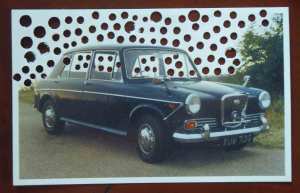
I was working today on some bits and pieces in the classroom, playing with materials and objects discarded from the the old DT room which is being closed up at the moment. I spent some time improving a postcard found at the back of a cupboard with some hole punches in the manner of Rachel Whiteread whose drawing show I saw at the Tate a week or so ago. I liked the work a lot and I was touched by her casts of the insides of boots which are a lot like the casts of shoes and bags I have on a shelf left over from a year eight girls interest in the artist some years ago. I didn’t know Whiteread cast boots but it seemed an entry level thing for a thirteen year old to cast so I was pleased to see these casts in the display of her studio objects which are a lot like the casts of my old shoes and a handbag on my shelf.

The atmosphere of the work is a lot like the DT room though. It is being emptied out and the traces of fifty years of it being a wood-work and metal-work room and then a CDT and then Dt room are being expunged. The remains of the wood store and some of the tools will be the basis for what I have decided to call the sculpture studio for this last year. The younger children will not get the chance to have the Mr Cope year eight experience because the school will be shut so I intend to give them some taste of the fairly ambitious work I attempt with the older children. Having said that I made the big Niki De Sant Phalle figure with ten year olds last year so there is no reason why they shouldn’t be capable. With the additional storage and building space though I should be able to make more than one figure at a time. And of course I have all that stuff in the cupboards that might be interesting to use one day, collected over the years, and now only a school year to do something with it.

Whitereads on the shelf at school

An afternoon spent in the print workshop devoted to the study and meaning of the edges of etchings.

I mainly like etchings, as much as I like them at all, because they are the remnant of a natural process of acid acting on metal, resisted by some sort of ground. If one wants to get all alchemical about it all then it is possible to be with all the talk of Dutch mordant and tree resin and bitumen and so on. I don’t find that particularly attractive myself, mainly due to the health threatening nature of many of the ingredients. However, the interest lies on the making of an image through the control of a natural chemical process of acids acting on metals. For me the nature of this process needs to be seen in the image so for me the edges of the plate are left as they are after the dipping and biting. This leaves them with a nice raggedy edge. I file them down before I start the process so I don’t cut myself on the metal but once it comes out of the acid I leave them as they are. I wipe them off when I print but the prints end up with a bit of a rough frame of ink from this bitten edge. This partly arises because of the way we back the plates with parcel tape rather than painting on a backing and using an edging paint to protect the edge which we could do. Apparently the real way to finish an etching is to ground down the edge to a 45 degree angle and then polish it with 600 grade wet and dry paper.

Nobody has looked at my beautifully framed etchings and said OMG, look at the edges on that and, as I say, I have reasons for leaving them. What I don’t like about etching is that some of it is about an etiquette of making and selling prints and less about the process as a way of making an art work. I enjoy the Chapman brothers playful attitude to the making of etchings using this fairly quaint process because it is a quaint process. I realised, however that, if I am to be able to say that I have learnt to etch then I need to be able to have the choice of making a well groomed print so I asked Ernst to show me how.

The filing and sanding is tedious but my first prints were disappointingly similar to my previous efforts. I had only done half of the process it would appear and Ernst showed me how to wipe off the edges properly and use the French chalk to seal the edge. This resulted in a more conventional and acceptable result though, to my eye, not necessarily better.

I know it drives Ernst up the pole that I don’t really want to be a fine printer and seem happy to bumble about at a level of relative lack of refinement. I seem happiest for the prints to be a form of drawing more than anything else and I am interested in them at that level. In some ways though, the prints have become less of an expanded form than my work before. I used to be happiest mono-printing  and using that sort of mark making in paintings and with other media. Now these prints have shrunk to tiny eight by ten inch squares of intense combat with the process.

Well, I can do an edge properly now anyway. Whether I will or not I am not sure.

Edge-2

My usual edge showing the acid bitten inked edge of the plate.

Edge01

The edge of the plate after clipping, filing down and then sanding. Edge wiped with a cloth and French chalk to seal the edge.

Obviously having a holiday from a PHd is unlikely but the closest I got this summer was a few wet days in Canterbury reading Cloud Atlas and drawing in the crypt of the cathedral. How much of a holiday that is, exactly, reading a different sort of book and drawing a different sort of thing I am not sure. Why draw on holiday? Do all art teachers take drawing things with them? For this trip I took watercolour paper with me and bought another pad of it in Chromos in the city. I drew with pen and a couple with pencil and I got particularly interested in the ancient and very mysterious figures on the columns down in the crypt. These were called jugglers and griffins and so on but they are very weird things. Apparently dating back to 1100. Fun to draw in the gloom and no photography allowed so the only way to get an image is to squint and draw. Will I do something with them? Is there an etching in there? I’m not sure at all and I am not sure the exercise is aimed at that, gathering material. It slows the eye down and forces concentration and looking at something closely and that is enough in itself really. I have lots of these types of drawings from all sorts of odd places. A long standing habit.

When I first got interested in drawing and realised that there was something there that I had to learn how to do, that it was a skill to practice, then I became an inveterate reader of ‘how to draw’ books. This was when I was between twelve and sixteen, when I was working my way through the books in the Anstey library. There were books called ‘How to Paint and Draw’ which showed you everything there was to know about drawing and painting. I practised how to shade and how to make things ‘three dimensional’ and so on. I was fascinated by the possibilities but, somehow, never that brilliant at them. My work always looked a bit, sort of scruffy somehow. Certainly I remember that there were some people who were much better at pencil rendering than I could ever be. I couldn’t really see the point in copying a photograph in graphite. I never really got the fascination with photographic realisation with art materials. This may have been because my Dad is a photographer so my other obsession was getting the f-stops right on my Lubitel 2 (real photographers just use an exposure meter to check they’ve got it right, Paul). Why draw photographically when you can put a roll of Tri-X in your camera?

Probably my favourite ‘How to..’ books were two by the artist and illustrator Paul Hogarth, Creative Ink Drawing (1968 Studio Vista) and Creative Pencil Drawing (1964 Studio Vista). Not only did he have a nice line, a nice loose line, and a very un-photographic manner, he also had a great Romantic back story about fighting in the International Brigades and knocking about Europe after the war and drawing the ruins in Germany. Every drawing had a story to go with it. I even wrote the guy a letter and he was good enough to reply.

Amongst all this ‘advice’ everyone insisted that one should carry a sketchbook at all times. This all coincided with ‘O’ levels and being expected to have a sketchbook. I was thrilled with the A3 spiral bound book I had when I started the ‘O’ level course at Quorn Rawlins. It is a habit that has stuck, on the whole, ever since. My sketchbooks were adored on Foundation and fascinated other students on the degree. And since then I have generally had one knocking about. There are a row of them behind me, A5 Winsor and Newtons.

More recently the habit petered out. I chatted to friends who did not keep books as a matter of course and I started to feel that the books were too closed down and shuttered up, that a lot of energy went into them which could be more productively spent making things that were more out there and exhibitable. I would buy a book and it would not get used, a few drawings at the beginning and a few clippings and then nothing. There seemed less point in keeping a book to have ideas in that I didn’t have time to realise.

Looking at the show in NUCA though, that wall of pictures, I realised where the sketchbook had gone. I had just made it a lot bigger and on lots of bits of paper. The impulse to make work like that, in the way it had been in the old books, when I had a sketchbook habit, was there in the wall of work. With something else as well though, more public and confident.

The sketchbook is now a ‘learning journal’ which is sort of working alongside this blog and a written notebook and a little sketchbook and bits of card and watercolour paper and the etchings and two paintings.

Drawing on holiday seems to have something of that lad carrying a sketchbook all the time, like the books say you should, about it. I resist the temptation to ‘draw interesting characters you might see in the street or cafe’ these days so I might have moved on a bit. Of course, one of the things I am doing is sort of demonstrating to pupils that you should carry a sketchbook with you at all times and that a holiday can provide you with new and interesting drawing opportunities. Whilst I am extremely unlikely to ever deploy these Canterbury drawings in the classroom I am, at some level, perpetuating the same drawing habits that got me going when I was a lad.

Whilst I can see that in some ways this is a good thing I can also see it as being really quite naff. It is part of the half life of the picturesque, clicking away behind notions of how to draw.

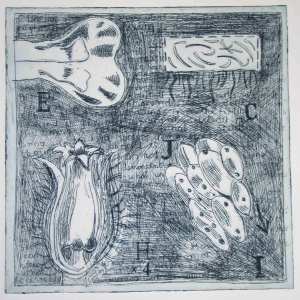
Botanical etching with obscuring layer of cross hatching.

Botanical etching with obscuring layer of cross hatching.

I spent Friday morning in the print workshop and pretty much wrecked the prints with an unnecessary layer of mark making on both. I wasn’t a very happy bunny by the end of it. The plate with the four botanical images on had a pentimenti on the flower head which was getting on my nerves. I should have blocked it out but I didn’t and it was a bit too much; not a very stylish bit of pentimenti. I wanted to tone it down and the writing too so I put on a layer of crosshatching which just mucked it up entirely- you can’t see the rather wonderful backward writing anymore and you can still see the pentimenti so that was a disaster.

I quite like the idea and the idea has evolved in the etching so I might rework it from scratch and without the cross hatching and with more coherent words.

The other print worked to a degree. I reworked the flower head and left it in the acid for a long time and that emphasised the image and obscured some of the writing more. The flower head is inverted, Baselitz style. It isn’t great though.

So, I have to ask myself how much this has been a worthwhile exercise. I have developed these two ideas through the process of etching. The layering of the mark making comes out of the process of putting a ground on, marking, printing, regrounding the plate and making more marks. I haven’t entirely controlled the process as well as I have with the  straighter drawing ones which I much prefer. I could prepare them more with Photoshop and so on, prepare the writing and so on. Though that works against the process leading to the idea. I could redo them as paintings or watercolours or monotypes.

The writing on the images is trying to get the voice of the artist, researcher and teacher into the work. And the idea of the images is to make work that directly relates to the (current) research question. These are supposed to be demonstrations, learning pieces. I am trying to learn about something so that I could teach it.

Some things have come out of these two pieces – the layering and the use of text. They could be laser cut prints like the cards I made. How the laser cutter would deal with a layered image might be interesting.

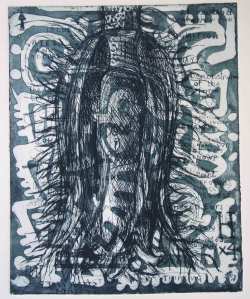
Second botanical plant image. Layers of abstract image made with Lascaux acrylic ground painted on and then car paint aqua tint with Dom. Further layers of writing and drawing through traditional grounds at NUCA.

What I tend to want to do is to be able to use a process so that I can improvise with it and have the process lead to ideas. I get frustrated if I can’t get the process to do that and if I feel that the process is dictating to me. I find the etching process quite awkward in itself which is interesting. It is slow and cumbersome and some of the etiquette is quite annoying.

Over the weekend I went over the Intaglio book and thought about what I was doing wrong. I also looked at the Edinburgh Printmakers website which has a nice easy guide to ‘safe’ printmaking, or at least safer.  The attraction is that this water based set of processes both makes etching much simpler as it just becomes about grounds and stopping out and also opens it out into something much more complex as the range of things you can use as grounds and stops is broadened out considerably.

One of the reasons why this has been quite difficult for me, I think, is because, as an art teacher, I have tended to learn new processes in a relatively simple, classroom friendly form. We can’t do a lot of welding but I can knock you up and nice Anthony Caro in heavy card board with a low melt glue gun. With etching I have learnt it in a fully professional workshop with all the facilities and safety gear and I have to re-invent it for doing it in the shed or classroom once all this is over. If it is to remain part of my practice anyway. Being able to make this sort of work in the shed would be different anyway. Having the process in your possession is different to driving twenty five miles to the art college, over caffinating myself in the many cafes near the art college and then driving home again. Talking to David and working with Dom this summer has made me think differently about it and I am looking for a way to take more control over the process.

I also started a large acrylic image based on the ideas developed in the etchings yesterday. I prepared a surface with a blue similar to the Lascaux ground that I used on the plates and painted on the Penck like image that I had thrown on to the copper plate at the summer school as a first layer. Today I have started to put the words on in similar blues.

Abstract layer based on the layer of mark making on the etching plate started at the summer school.

Do I want the writing to be legible? Or do I want it to be semi-legible? Or not at all legible? Just a sign of writing being there as a visual thing? What is the point of writing being there if it isn’t legible? A sort of mumbling.

The idea is that the thing will look like a page of notes from a learning journal in some way.

This slideshow requires JavaScript.

Back in the etching studio again. Very quiet and peaceful and an entire art college printing studio to myself. Can’t be bad. Two plates on the go today. I worked on them last Thursday in here and I am trying to finish them off today. The two prints are left over from the summer school. Both are plates that Dom gave me, one a squareish one and the other more of a vertical rectangle. On both I have put on traditional resin grounds and worked through these again. One has been done twice and the rectangle is on it’s third ground, this last time with a motif from the old botany books that I have been using. These should be the last dip and they will be done. I have experimented with writing on the plates. One has lots of little, pretty obscure messages on from the summer school, Grayson Perry style with logos and so on and the other one has handwriting on. I also want to do something like ‘Another nice etching’ by the Chapmans. We’ll see how that turns out.

Last week I had another go on the laser cutter and this time much more successfully. I had trimmed down the image in Illustrator so that it was simpler and we reduced the size of the result by about 25% so that 24 fitted on the A1 card. The result took just over two minutes to do for each card and so the whole sheet only took 45 minutes or so. This meant that the individual card had less invested in it, as it were, so I am more likely to post them on, which was the intention – a postal art piece. I think this is the way to go; using the machine to make a ‘print’ type object rather than a plate. There is some exploring of the raster idea and the possibility of making a lino cut with the machine which I should explore further next year. The way the machine etches type is impressive and a lot easier that my trying to write backwards on an etching plate. There are photo etching options I could no doubt try out.

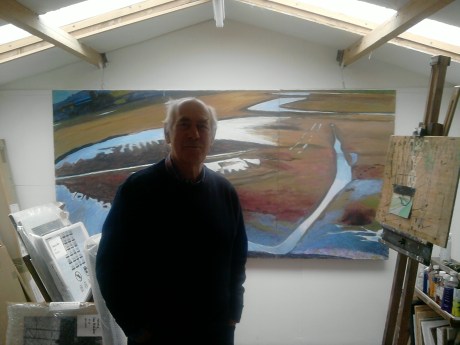
I gave David Page one of the tiles yesterday and he was intrigued by the effect. We discussed his adventures with liquid grounds and copper plates. He had made a very fine little ‘hunter in the snow’ etching on a tiny and very ancient press. This NUCA print studio is so well equipped for traditional techniques that the idea of doing etching in the shed takes a bit of thinking about.

David Page in his studio