Introduction
This case study is about the making of a sequence of fifteen ceramic plates in a middle school art room as an example of art practice in an educational context. These plates and the continuing sequence is to be presented as the final part of the PhD report. The making of the plates represents a summary of the findings and themes explored in the research to date.

Context
The plates have been made in the middle school art room as part of the daily life of the classroom and as part of the making of demonstration pieces for use in the classroom as an art practice. The ceramic plates have been made to explore learning and teaching about art in both form and content. The plates have been used to support teaching in the classroom and the process of their making has been demonstrated in the classroom.
The middle school that I work in is scheduled to close in July 2011. This is reflected in some of the plates which represent reflections on an art career in education. I have also been working in the role of head of year eight over the past year which has been onerous and stressful at times. The state of the school, uncertainty over the future, staff morale and the mood of the children have been the background to the making of this series of works. In many ways the focus on making work has been a welcome distraction and a solace from these working conditions.

Why Plates?
The only training I have had in ceramics was during my year of teacher training at Middlesex University. Before that there were a few childhood pots at school but nothing else. During my teaching career I have used ceramics extensively as a way of teaching the 3D element of the National Curriculum. Once I got used to firing the kilns I found in middle school art rooms I became more confident in using clay with children and more sure of successful results. Most of the children like using clay so I found it a good way to engage children. Many teachers don’t use clay because of fears over health and safety and behaviour with what is basically posh mud in a classroom. I found that I could use the clay to ensure good behaviour as if they didn’t use it properly I stopped them using it at all and this has a generally been an effective sanction.
The teacher at college was very enthusiastic about ceramics and the history of pottery and he opened it up for me and made me think about the history of the material. I have often told children about the tiny Roman pot that he showed us. It had the finger-prints of the maker on the base where it had been removed from the wheel.
What is so powerful about using ceramics in the classroom is the way that it connects the lesson to this whole history and technology of 10,000 years of ceramics. We are practising a sub-genre of ceramics called children’s pottery. Whilst down the road friends of mine make studio ceramics and in Stoke-on-Trent someone is making lavatory bowls. And not far from us there is a workshop making a revival of Lowestoft Porcelain.
Though I have developed a certain level of skill in ceramics over the years it is not high. I don’t do it often enough and I have not had the practice to get very good at it. My technical understanding of the process remains relatively basic. I can get children to make objects with buff school clay and terracotta, glaze them and have them come out of the kiln in one piece. In this way my pottery skill is entirely a thing of my teaching and thus seems a good way to explore the ideas about the classroom demonstration. All of my ceramic work takes place in the classroom and is an entirely classroom based sort of work. The things I make in clay always seem to me to have the mark of the classroom about them. They never transcend the classroom setting. I wanted this to be part of the work.
I was also interested in developing these ceramic skills with a sustained focus on the material. One of the themes of the research and of the practice in the research is the wide ranging nature of the practice and the continual distractions of working in a school. I wanted to try to concentrate on a set of work in a relatively narrow range to try to think about this aspect of the work.
I was also interested in the idea of skills and craft in the art curriculum. As my work has taken me into different phases of education I have become very interested in the different attitudes towards skill in these different phases. The National Curriculum in its various incarnations and current confusions, exam boards, foundation and degree courses and the art market in its myriad forms all seem to have different notions of skill. There is no single view of the value of skill in all these different viewpoints but a great number of assumptions. I think that what I am doing is showing students some creative thinking methods through the manipulation of materials and media. In this set of works I am trying to use clay as the medium to explore some creative ideas and ideas about process. I am also trying to show them creative engagement, an artist becoming quite obsessive about pursuing an idea.

The first plate
11th February 2010
From mind’s eye to object. How does this happen exactly? How does something go from being in my mind’s eye to becoming an object that everyone else can see? It’s a complex process, much of it inside my imagination but it is my imagination interacting with the material world and with people. It can be recorded at the time but sometimes it only becomes clear at the end. The plate started in come idea about how Roberts (2007) is wrong and that eh physical world and ideas is what is important and that the hand can’t and shouldn’t be taken out. So I was thinking about craft and plates and how the kiln in a middle school tends to produce work that looks like it was made in a middle school. Then I saw a link to an avatar making program. I made an avatar on this, for fun. I thought the result was funny but not much more. Then I thought about cutting it as a stencil to use in a painting. I reduced it to a black shape in Photoshop ready for that- ready to use a plotter to cut it, to be indirect. The machine was never going to happen so I went back to the souvenir plate idea which had evolved independently through Thomas Toft. So then I painted the image onto a plate. It being funny to paint a dematerialised avatar onto a dodgy middle school plate. Somewhere around here the mental image of what it would look like appears in my mind and then I go through the process of making that physical. I was very pleased with the result this morning. It doesn’t always work out as it didn’t with the CAD embroidery. And the process isn’t always like that either. Some things emerge before my eyes slowly and I find out what I meant later. And then there is doing the same thing through the children as per a lesson I did the other day that was observed by the deputy head. (From notebook)
The lesson I am referring to involved having the children making a ceramic mural that fitted together out of tiles that they made. This was a development of a painting project with connecting paintings. What I am interested in my own creative ideas and how they are communicated. With the plate I have an idea that evolves from an aside into a physical object that can be shared with others. With the class I am having an idea that I am getting the pupils to fill in, as it were. I am constructing a lesson that will fulfil the criteria of a learning experience for them and will generate a work of art. This seems more indirect, a mixture of an artistic imagination and a pedagogical one.

Further Plates
Following these, made in the Spring of 2010, I made no further plates but persisted with the etching project and drawing. As the new school year got under way in the Autumn of 2010 these plates and the positive reception that they had got were still in my mind.
In conversation with a friend about the project he referred to the idea of showing someone how to make a pot as an example of the sort of demonstration we were talking about. It occurred to me that the pot as a thing you show someone how to make is often mentioned in these conversations that I have about the project. It is the obvious metaphor.

If I make a pot to show you how to make a pot does that make the pot different to other sorts of pot? If we take that pot and put it in an art gallery does it look like a different sort of pot? If I make a pot to show myself about making a pot does that look different and if so how? And what have I been demonstrating? Practice having a skill-can I demonstrate my own learning or understanding to myself? (Notebook 30th October 2010)
I had been looking at Richard Prince and Lily Van Der Stokker and I was interested in their use of humour and text in their work. The first two plates I made to demonstrate a paper stencil technique used a rabbit drawing based on the work of Ray Johnson that I had used in a mail art project I had done the year before with the children. The other one was based on a Lily Van Der Stokker piece “I am an artwork and I am 3 years old”. These were made with newspaper leters cut out and placed on the clay and then coated with a layer of slip. The letters are then removed to leave the clay showing through. The Johnson plate was clear glazed and the Stokker piece was glazed with a blue speckle glaze. I had to glaze it twice as the first time it was ruined by a foot falling over a pupil’s clay figure and landing on the plate, sticking in the glaze. I had filled several pages of sketchbook with ideas for further plates.

Commemorative Plates

For the next set of plates a number of ideas coalesced around them and I began to research ceramics more actively. I started thinking about royal plates and the Thomas Toft slipware plates I have always enjoyed. I spent an afternoon drawing in the Castle Museum and I saw a number of plates and vases that had been made to commemorate various naval heroes from the Napoleonic wars. Nelson was just the most famous of the celebrated heroes of the sea, it would appear. I tried to base one of the plates on an image of Nelson. The idea being to commemorate my teaching career at Gisleham as the ship goes down around me. I was considering myself as some sort of Victorian educational hero, famed on plates.
I was also intrigued to find plates commemorating Admiral Keppel in various tinware forms. Keppel was court martialled for a naval mishap but was found innocent. This event kept the plate and bowl manufacturers of Staffordshire going for quite a while it would appear form the number of pieces with his image on in various collections that I have found.
I drew his image and used it as the basis for a self-portrait in the manner of on two plates. The point being that we are awash with naval metaphors at school. I am often told that I will find it difficult to work in a bigger school as I have been the captain of my own ship for so long.

What Made You Want to be an Artist, Mr Cope?
A further set examined the beginnings of my wanting to be an artist. I was trying to think back to when I was the age of the children that I teach. This is often in my thoughts whilst not really thinking much about my own childhood, in many ways. It is a focus on the art auto-biography more than anything else. I see children who seem to have a similar relationship to art that I had and there are the same sorts of enthusiasms amongst the children for different sorts of drawing as there was when I was young. Sci-fi and comic strips and horses and flowers. The Stokker work made me think about male equivalents to her work though this didn’t seem that productive. The male equivalents are what we are more used to as ‘art’ which is what gives her work the point.
One of the plates uses a boy’s drawing of a robot figure which he had actually given to another boy. I have used this boyish interest in robot figures before and another plate features a dalek. This interest stems from the games the boys play on their entertainment machines and the prevalence of sci-fi in popular culture.
When I was twelve the main thing I drew were real space men and Napoleonic soldiers. One of the plates features a drawing of a French hussar based on a fairly inauthentic painting found on the web. I was fascinated by these uniforms and the strangeness of getting dressed up like that to go to war. Some early drawings which garnered praise were of these soldiers, as I remember.
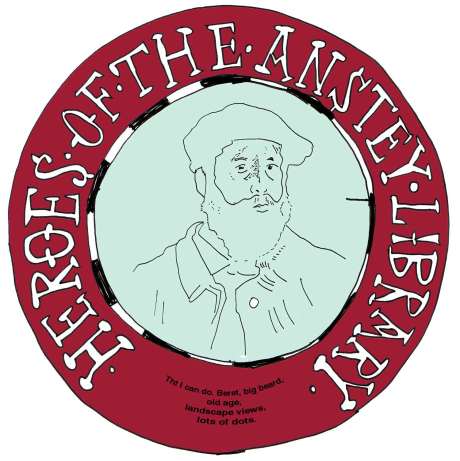
I have been using the various plates I have made and the learning journals as demonstration examples with the year eights over the past three weeks. They have been tasked to make a small plate with the circular tile cutter that we have. The pupils have picked up on the Grayson Perry vase of his childhood heroes which I have used for a ‘Heroes of Anstey Library’ design. They have done a lot of footballers.

What is quite interesting is the way that tracing has become a big part of the project. One of the pupils mistook some Pennsylvanian pin decorated ware of a horseman riding by for Thomas Toft’s work. I pursued the links further and found out more about the images. I have based two plates on the horseman who was apparently a stock figure in Pennsylvanian ceramics in the late eighteenth century. The second one I used a pin decorated method which gave the lines a certain quality but did enable a pretty accurate transposition of the photocopied drawing I used. The pupils have really gone for this and some of the results have been very fine. A girl this afternoon rendered an old fashioned car using this method which worked very well.

If I hadn’t got so involved in making plates myself then I wouldn’t have pursued these lovely Pennsylvanian plates because the link was because of my drawing of a hussar on a plate. It was because I was interested in making plates of a horseman riding by that I picked up on the serendipitous research image and following it through into something that has been so useful for the pupils.


Design for a commemorative plate

Design for a commemorative plate about Monet


I finished another learning journal or sketchbook yesterday in a sudden rush of glued in drawings from the British Museum. I did have a notebook with me which sometimes serves as a sketchbook but I also had a pocket full of postcards and I drew on these instead with a fountain pen. I should have taken some shots of the cards as a pile as it was quite nice to have this pack of shufflable ‘culture cards’ as it were. What I actually did was paste them into the current sketchbook along with other bits and pieces and some photo thumbnails that I had taken with a digital camera. I used this book at school when I was explaining to the pupils how we were going to design our commemorative plates.

I was using my plates, my current practice, as the instigator for the project so I was trying to share with them the inspiration behind my “Admiral Keppel” style plates of a doughty head of art on a sinking ship. As I did so I was thinking about how much the work that I did last summer on the learning journal module for ARU has affected the books. They are packed with huge amounts of detail, much improved referencing and layers of complexity. What I am trying to do is demonstrate something to a future self much more. I am packing up the ideas with a view to unpacking them in the future. I am using the book as a thought technology in a much clearer way than I was before. They make my old sketchbooks (ordinary ones) look utterly casual, letting the reading of them to pure chance.

I don’t decorate the books much, I don’t embellish them with much more than layers of notes and pointers. Beyond the odd bit of collage here and there I just lay them out with gaps for later notes and in fill. They remain pretty chronological, on the whole. I have had a run of using spiral bound books and quite a lot of glueing in. One of the books has black pages and is written in with silver and white pens as a nod towards the idea of journal as scrapbook.

I don’t know what the children make of them but the books do seem to be a much more deliberate presentation of practice than before.

With the year eights I am demonstrating a set of six plates, one for each group. I picked up on Grayson Perry’s ‘Heroes’ pot which I saw in the V and A a few weeks ago when I was drawing in the ceramic galleries. I had the idea (on the 15th January, according to my book) to do a plate about heroes of the Anstey library: towards a job definition. When I was a lad first getting interested in art and being told by peers and some teachers that ‘you really should be an artist, Paul’ I spent a lot of time getting all of the art books out of the Anstey library. I was a committed reader and I read my way round this little library from 1972 to 1977 a couple of times. I was fond of military history, sci-fi of the more cerebral sort, Orwell, art books, drawing primers (the best being Paul Hogarth’s ‘Creative Pen Drawing’), Huxley, and Alistair MacLean. I did not grow up in a house with a great deal of original art beyond my mother’s amateur oil landscapes. There was a print of a chuckling cavalier on the stairs, a couple of Canaletto prints and a writhing black bronze horse with a snake wrapped round it that gave the shivers.

So I had to come up with a job description myself. There was Graphic Design or Commercial Art which I was a bit too flakey for, really. Rather unbiddable for the commercial world. And then there were the lives of the Great Artists int he black Thames and Hudson volumes. What a great bunch of role models they were too. So my plates are dedicated to six wry art heroes of the Anstey library. I think this was all rather lost on the children who were with me as far as Admiral Keppel but stopped getting the jokes thereafter.

One of the things that came out of the physical process of making these designs was tracing the images. I traced the first one about Gauguin and realised that this simplified my source somewhat and seemed to make the possibility of carving it into clay way more achievable so I grabbed some old drafting paper out of the old DT room and found the old light box and we were away. I got the pupils to trace their pictures of Eric Cantona and Bobby Moore (?) and it all started to look a lot more likely to succeed.

The whole process of inspiration from Perry, Toft, and Keppel, of day dreaming in ceramic museum spaces and letting these ideas mull and intermix on bits of paper in books looks fantastically complex and individual. And a huge amount of work. I have been committed to this for some time, if not obsessed. I have really pursued these avenues of thought with pen in hand and the journals and helped me do it. I am modelling obsession, partly. And now I have turned it into a viable school project. It doesn’t look that self evident at all.

I lie awake at night planning sprig moulds of fruit gums.

After the Christmas and New Year lay off I have got back into making the plates again. I made one last week which is another demonstration plate, showing a range of decorative ideas to help the pupils with their commemorative plates. I have had a lot of fun in libraries and museums following up research ideas and I have learnt a lot about pottery.

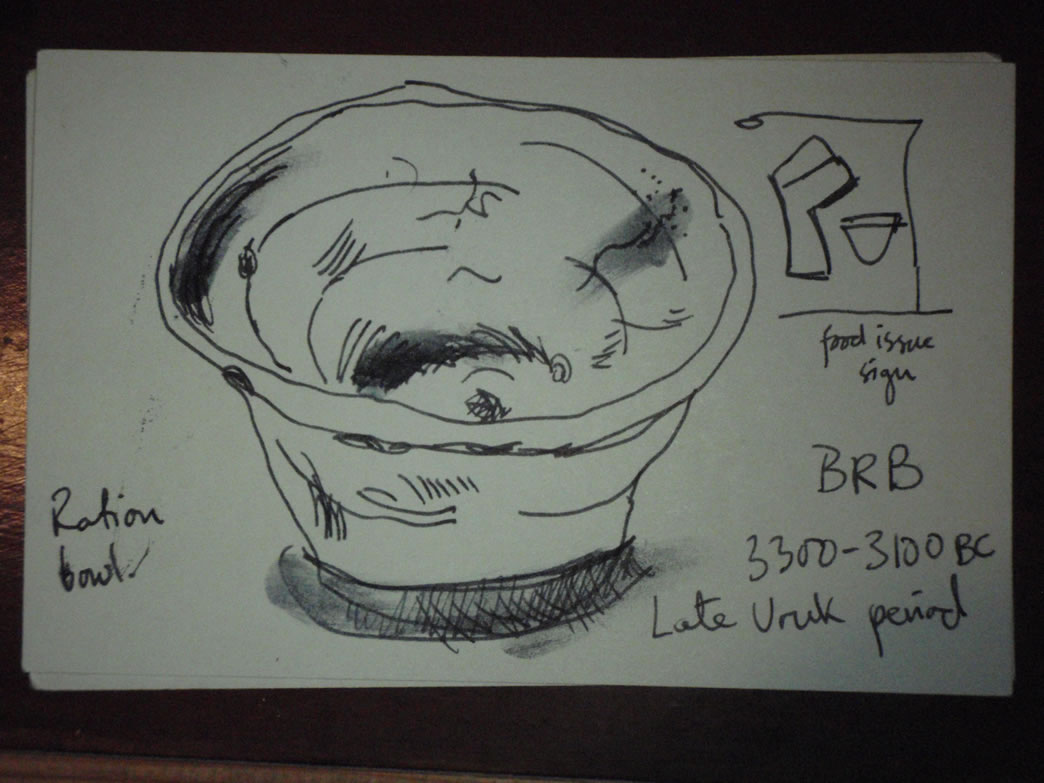
I was in London Friday and after the course finished I made it over to the British Museum for their late night opening. I was particularly after seeing a BRB, a bevelled rimmed bowl from Mesopotamia. I saw these on a BBC programme about the dawn of civilisation. They are apparently so plentiful around Tell Brak that the archeologists have to rebury the things. I made a little drawing of this really very humble object which is symbolic of a great deal.

It is thought to be a ration bowl because of the standardisation of the the size, pressed into a standard mould as they are. This implies that one group of people were being rationed by another group of people, that there were workers and overseers already. Social organisation inferred from a pot. Very interesting. I also found tin ware plates and a huge Thomas Toft platter and spent a couple of hours sketching.


The year eights are working on their big, life size paintings about them selves. They are going well and most of them seem to be enjoying the project. Some have found the scale of the things a bit difficult and this weeks theme was how to get small things onto big things, how to deal with scale and how to get small scale things onto these big images. I showed them the Paladino Dream paintings, not because they are directly relevant but to show them the idea of making something on a separate material or paper with a view to building it on later. We also experimented with stencils and a bit of screen printing on paper and onto the big paintings.

I also did some big drawings based on tiny thumbnails that the pupils had printed off the web and a drawing based on a half remembered idea of Homer Simpson. (Half remembered is important in this research project.) And one of the lads had some drawings of skully roboty figures which I liked because they had interesting gaps between the arms and body, they weren’t all joined up. Where these things come from and what sort of image mash produces them in boys heads I don’t know. It were all Thunderbirds when I were a lad. Obviously this is a sort of continuation of sci-fi imagery with additional computer gaming, Alien and so on and so forth minced up inside thirteen year old boy’s heads and produced as drawings. Great stuff and I was hoping that this sort of thing would come out. I sent the boy off to have the drawings photocopied so that we could collage the copies on rather than use the originals.

I borrowed one of these photocopies and made a drawing with black acrylic based on this little A4 sketch. I made it A2 and then it grew and I stuck another piece of paper on so it ended up as a long piece, quite big. I did this to demonstrate the idea of taking a drawing and re working it in a different way and at a different scale and I was interested in co-opting or assimilating this boy’s drawing.

The next day I was running through these ideas with the next class and I showed them this big picture and explained that it was based on William’s drawing that I had liked. After a bit a lad came up to me and asked me if William had really told me that it was his drawing because it wasn’t, it was his. He had given it to William and he had filled it in and finished it off, put his name on and evidently claimed it as his own. Quite what this lad had thought when I had held up a big version of his drawing and shown the class I don’t entirely know. He said he didn’t mind.

We had an interesting chat about his drawings and how he felt about them. He obviously used it as a powerful means of expression for him. They are all robots with skull heads and flames and mechanical arms and so on. A4 paper, shaded in pencil drawings. I wrote in his diary and told him that he should feel proud that someone liked his drawing enough to make a copy of it, it was quite an accolade that the art teacher liked his drawing enough to do that. I also told him he shouldn’t give his stuff away and certainly not to people who claim it as their own in quite that way.

I was also a bit embarrassed because I had been caught out making a pastiche with the permission of the wrong boy. And we were all in a tricky world of ripping off other off and the internet and every sci-fi film ever and nicking each others drawings and I’d sort of joined in. I guess I owe the boy a robot drawing.

When I realised what had happened I thought, wow, this is a great page of PhD. It will make a great plate.

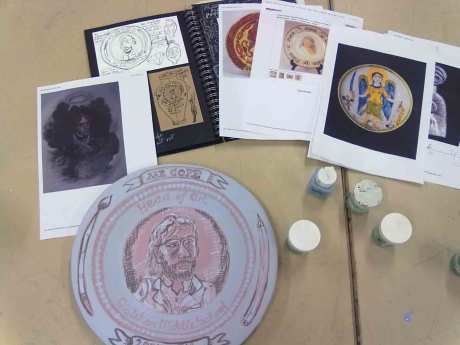
Source material with greenware plate and under glaze.

I had a bit of a gap between school and a meeting about being made redundant so I stayed at school and used the classroom as a studio for an hour or so. I worked on a commemorative plate, channelling Grayson Perry and Gavin Turk with a plate to commemorate my ten years at Gisleham. I used some under glaze on a buff school clay with a couple of layers of blue slip on. I used a few pictures from a google search around commemorative plates in general including a well cheesy one of the queen mum. I based the self portrait on a picture of Nelson (local lad) and this has sent the face a bit off kilter so I might have to rework that a bit.

So before half term I made up a pile of images with the idea of making a ‘dream of Paladino’ piece as a tribute and as a way of thinking about the use of fragments in Paladino’s work. After half term I walked back into the classroom and saw the pile of things on the table and momentarily forgot why I had done it. And then I wondered why I had thought it was a good idea.

After a bit I decided to use them anyway and I quickly put together two ‘Paladinos” which worked quite well. I am not sure what they have to say about fragments though. There is something different about making fragments deliberately to put together into an image. I know what I am doing and I am planning ahead really, I am just building an image out of disparate bits. I make some more fragments on some more varied materials around the art room and make up another one on a small canvas. Not really very happy though. For the research project part of the point is that the different bits of the fragmentary practice are more broken up than that, more separated by time and materials and intention and part of the point is that they only look evenly vaguely coherent after the event. This is different to the bits being made as fragments.

To make a work out of fragments then the work has to be accidentally made as fragments, almost. If that can be done. Certainly I have been thinking more about leaving things undone or half done and not having the same need to ‘finish’ things. But I am not sure how I can deliberately make accidental fragments. Perhaps the point is that all of the work is made of fragments of time and effort and leave it at that.

Is everyone’s? I suppose I am again contrasting this with some sort of Ideal Artist deeply delving into their practice in long lonely uninterrupted hours in the studio as opposed to making stuff in the gaps.

I did a lot of ceramics work with the pupils last week and this and I made a couple of plates up whilst this was going on. I liked these a lot and this has started a chain of thinking about commemorative plates, Grayson Perry, Richard Prince and Lilly Van Stokker and further text pieces in clay.

Introduction

The original inspiration for the research came from looking at the examplars I made in the classroom to show the pupils a particular technique or idea. I have long thought that showing them ‘one I prepared earlier’ was not very useful as it takes a skilled eye to be able to unpick how an image or object was actually made. It is more useful to see a piece of work being made before your very eyes and so I actually make work in front of the pupils. Whilst doing this, I think about the ways in which I learn to do something; it makes my own learning more apparent and I am then better able to communicate this and the process helps me to anticipate the tricky bits. So, it has been a long-standing habit to make work in front of and alongside the pupils. This sort of work though, made as it is with cheapish gouache on sugar paper or £1.99 watercolours on cartridge paper, I didn’t consider to be ‘my work’. I had my own paintings and other work and then I had this utilitarian work I made in class. I didn’t value it as part of my art practice but then again, I nearly always finished the work and didn’t throw it away either. So I valued it in some way.

I never threw it away because I remember when I was twelve, an art teacher showing us how to throw a pot, then knocking it over when he had done. We were shocked and disturbed that he did this. He said he had lots of pots at home but it still seemed shocking to be able to make something as well as he had but not value the outcome. So I don’t throw them away and I tend to finish them. I give them away sometimes, to adults, not pupils. I let the frost destroy the pots in the garden and I keep the forty-five or so self-portraits in the manner of Modigliani amongst the drifts of work in the art room.

Part of why I value them is because they often have a looseness and freedom that my more considered work doesn’t have. Some of the paintings, made with cheap paints, have a quality that work with acrylics on canvas or board don’t have and I am fascinated by this aspect. Making work in front of thirty children can be less inhibited than work made alone in a studio. I am concentrating very hard on demonstrating the idea and the decisions about why I am doing it have been made at a much earlier stage. I also become very practised at making the particular pieces as I am likely to do the same demonstration four or five times in a. I might not make a mono-print based on a drawing from the Sainsbury Centre again for a year but for that week I become very focused on that particular method. The demonstration is more of a live performance than a studio recording, with more energy in a short space of time and different production values.

Part of what I am doing is modelling the project and giving the children a target but I am also validating their work by showing that it was worth an adult doing it too. I also finish the work for fun, for pleasure and because I am practising making art. I am still running through the learning exercises of being an artist like a musician practising scales. Though now I have set the exercises partly out of a consideration of what I wish I had known about art when I was their age. Anecdotally, art teachers have told me that they have collections of work made in this way. They have not considered these as their ‘own work’ either and we have discussed the possibility of making an exhibition of these ‘lost’ works.

This research project is a subsection of the interest in the artist teacher and much of the initial research was guided by the literature on various artist teacher projects thus far. The development of this interest in the demonstration as a form of art practice is a response to a the lack of detail in the current research about the effect that the art practice of the art teacher can be said to have in the classroom. This project proposes that all art teachers who make demonstrations in the classroom are carrying out a form of art practice. An examination of this neglected or lost aspect of teaching and art practice is the original contribution to knowledge.

The research question, therefore, is ‘Can the classroom art demonstration be recontextualised as an art practice?’

The research process is based in case studies about working in the classroom with pupils aged between nine and thirteen in a middle school. The art practice is inspired by the teaching and learning process in the classroom and vice versa. The work considers the role of skill in art, of learning to draw, the nature of what is demonstrated and learnt in art lessons and the notion of influence as an educational tool.

The art and teaching practice is conditioned by the restraints of the school curriculum. The art practice has been guided by the school projects. The artwork allows the different influences and projects in the classroom to wash through it, trying on multiple artist’s practices. The demonstrations in the classroom have become the whole of the art practice and work made beyond the classroom is seen as a demonstration. What the artist is demonstrating and to whom becomes part of the work. The artist is demonstrating his or her own work to themselves in the studio as well as the classroom. The art practice examines what it is that is being demonstrated and what that might say about the relationship between the artwork and audience.

Case Studies

The research is centred on five case studies. Four of these are based in the classroom and examine different projects over a period of three school terms. Three of these projects use an orthodox teaching method, using the work of an artist as a starting point. One was based on Alan Davie and Sandra Blow, one used camouflage as a theme and the third, called How to Paint and Draw, was based on observational and expressive painting and drawing. The fourth project concerns a visiting artist, Craig Kao, to the classroom.

The fifth case study is the art practice of the teacher. This is the major part of the study. The art practice case study covers a range of work over the duration of the project that relates to the teaching practice and shows a development of the practice based on the demonstration in the classroom. The work produced in this fifth case study relates to initial case studies. An analysis of the classroom case studies and what has been discovered from them provides further material for the art practice. Some of the conclusions and outcomes reached in the art practice have fed back into small art projects in the classroom as part of a dialogue between the two practices.

Etching

As part of the research, I learnt how to etch at the art college. This was a way of becoming a learner and putting myself in the position of a pupil acquiring a skill. I had done little etching before, partly because I had not found it a particularly conducive medium and partly because of the technical difficulties involved. It is not of much use in the classroom due to the health and safety issues and I realised that most of the skills I had acquired during my teaching career had come about due to their usefulness in the classroom. In this way my teaching and working in a middle school has conditioned my art practice and guided it in a certain way. Some media and techniques are more applicable than others in the classroom and my skills have been extended in paper-mâché and large-scale cardboard sculpture in a way that they might not have been had I not been a teacher.

The etching process has produced a set of etchings along with writings discussing being a pupil learning a craft skill, the sort of work that has been produced using this skill and how that might relate to contemporary practice, particularly the work of the Chapman brothers and Paula Rego. The etching has fed into the classroom project on Alan Davie and Sandra Blow as some pupils made dry points with a small press and I have shown the etchings to pupils and displayed them at school. The awkwardness of the process and the interest in drawing that the medium has provoked has related to the How to Paint and Draw project.

One theme of the art practice is how one learns about making art and how that learning has informed teaching. My art education and subsequent teacher training, the expectations of the education system and those of the pupils and parents inform what I teach and how. The folklore of art and artists affect what happens and the background that the pupils bring to lessons. The mythologies and common-sense views of art have also affected how I learnt about art and how I went from being ‘good at drawing’ through art college to art teaching and art practice. I have this in common with many art teachers and I see pupils who are ‘good at drawing’ in my classes.

Another theme in the art practice is drawing – notions of good drawing and drawing to acquire the skill of drawing. Drawing manuals and the exercises and clichés of drawing are referenced ironically and are used in the classroom and art practice. I use drawing a lot in the classroom but I use it to express, to map, to imagine and to communicate as much as to observe and analyse. I use a wide range of media to draw including print, computers, paint and clay as well as more traditional pen and pencil. This has meant some arguments with external inspectors expecting evidence of more observed drawing. One of the points against an emphasis on observational drawing skill in the classroom is that it alienates the majority of pupils who find the process difficult and confusing. The intention of a curriculum based on a broad range of artists and media is to try to give as many pupils as possible a positive introduction to making and thinking about art. This is sometimes referred to as inverting the pyramid. This means a project based on colour, collage and Sandra Blow that does not foreground drawing skill will appeal to more pupils than one based on observational drawing skill that values ‘good at drawing’.

Alan Davie and Sandra Blow

This was the idea explored in the classroom project initially based on Alan Davies and the free associative drawing practice he uses to generate ideas and images. We took this as a starting point and then developed imagery through a range of media and techniques including paint, collage, and printmaking. As the project progressed, we looked at other artists such as Sandra Blow whose collages were very popular with the pupils. Alongside this project I made a large number of drawings in the manner of Davie as I developed the project and I made prints and paintings as demonstration pieces in front of the children. I also made three large paintings based on Davies and a series of collages based on Sandra Blow. These have been exhibited at NUCA and in a small show in Suffolk.

An interest in abstract art has been a further theme in the art practice and I have produced a large number of painting studies inspired by Jonathan Lasker and Thomas Nozkowski. This is part of a theme about influence in art and art teaching. The intention is to use the work of an artist as a benign influence in the classroom as a part of modeling or the scaffolding of a learning experience. It is a way to present a historical view of art and to introduce children to the work of artists through the visual. It can serve to introduce a range of voices into the classroom from different times and cultural viewpoints.

Artists have always been influenced by other artists and has been a way to learn about art. Many artists have made work based on or inspired by the work of artists that they admire. Much art is a conversation between artists through art works and this continues into contemporary art. This seems to validate the use of artists in the classroom though it causes some problems with notions about originality and creativity.

I think of the art projects as a series of games with rules in different places. Art can be considered an etiquette, a way of doing things. The use of artists’ work in the classroom introduces children to the idea that art can be made in a wide variety of ways about many things with many materials. This week we are being neat and tidy and staying inside the lines and next week we are splashing plaster bandage around on a large sculpture together. A set of rules allows the pupils to express themselves in a certain way and hopefully think about the work of an artist and acquire some technical insight into a medium or technique.

One of the things that has altered through the project is this methodology. I am experimenting with more tangentially influenced projects where the work of artists has influenced me in the construction of the project and I use the work of artists less. In a way I have expanded my role as an artist in the classroom and used myself more as an interpreter. Previously I have tried to be transparent and present the work of artists in a neutral way. Some of the work I have done with pupils has shown me that my role as interpreter and presenter is considerably more of an influence than the artist I am presenting. When I use the work of an artist in the classroom I bring a l present a synthesis of what I know about the artist and present this in a way that makes it accessible to the pupils. This has led me to think about my role as an art teacher in the classroom and to play with the role of art teacher. Some of the art practice is based around the persona of an art teacher who has become a semi-fictional figure. By stepping outside, questioning and making work about the role, the presentational and performative aspects have become more apparent.

This realization that I am acting as an interpreter comes out of work on the teacher’s voice taken from transcriptions of videos of classroom demonstrations. This voice has become text on paintings and drawings as I explain how the work I am demonstrating is being made. In this way the internal scripts that teachers use become more apparent. A number of works with running commentaries on them have been produced.

Visiting Artist

Questioning the role of the art teacher has also arisen from the fourth classroom case study involving the visiting artist, Craig Kao. Craig was with us for a week as part of a Sainsbury Centre of the Visual Arts project on Culture in the Countryside. We cleared the art room of as much as we could and filled the space with large amounts of found materials. We left the timetable as normal for the week. This was partly to cause as little disruption as possible to the school and to ensure that the maximum number of children would have the experience with Craig. This meant that the artist was obliged to work within the constraints of the teaching structure of a school as a new set of children appeared each hour. Craig obviously found this quite difficult as he was unused to working in this way and has no teacher training.

The week heightened my awareness of my role as a teacher and as an artist as Craig and I worked together on a series of collaborative paintings and sculptures with each other and the children. The results were exhibited at the Cut gallery in Halesworth in October 2009.

The experience made me very aware of the channelling and institutionalising effect of working in a school; how used one becomes to the structures and expectations of the school day. Not that Craig and I really stepped outside them but we moved them around and we did something more unexpected with these strictly allotted hours.

Phalle

This led me to a take a different approach to some projects thereafter, particularly the Nikki De Saint Phalle project that I did with a group of ten year old children. I decided to try to be an artist in residence or an imagined notion of an artist in residence with the project. We set off with paintings and then made a collective sculpture with a cardboard armature and a paper-mâché and plaster bandage skin. I was much more directive as if I was the artist and the group were my assistants. I split the group into teams for each section of the figure and then we put the parts together and plastered it together. We finished off with acrylic paint and we also made a set of studies of the marks for the surface that made a sort of skin of the figure which we exhibited as a large painting. The result was exhibited at NUCA in February 2010 and at the school.

By being my own artist in residence I mean that I foregrounded the artist aspect of the role and tried to imagine being Phalle working with nine year olds to make one of her sculptures. I went into the room more focussed on getting them to make a very large scale figure rather than on constructing lessons with learning objectives. I worked with the resources I had to achieve the artistic result that was more in my mind than theirs. My improvisation resulted in my getting the size quite wrong and the only way we got the piece to Norwich was by borrowing a builder’s lorry to move it. The pupils got a lot out of it despite the lack of formal learning objectives. They came down at lunchtime to put the plaster bandage on and to paint the figure. The project began to step outside the constraints of the lessons and inspired and esprit de corps in the group that still exists when we work together. The project did generate the sort of excitement that an artist in residence project often does.

The rhythms of the school day and the school year have become evident in the work. The fragmentary nature of the work becomes more obvious as ideas are pursued but only so far, conditioned as much by the attention span of the children as by that of the artist. There is never enough time to be thorough, as the curriculum demands a move to cover a new topic or method. The teaching practice conditions the art practice. How the two have become interwoven or mingled together is part of the art work and it becomes difficult to tell what the art practice would look like without the teaching practice.

The art work, some class work and accompanying writing has been catalogued on a blog over the past year at http://www.paulcope.com. The art practice and class work has been exhibited at NUCA, the Cut in Halesworth and at Wingfield Barns as part of the SCVA Culture of the Countryside project over the past year. The work has been extensively recorded through a series of learning journals and sketchbooks and there is an extensive photo archive.

‘I have a great love of things that human beings have made. Visual things; some of which are utilitarian, some are made for aesthetic pleasure. I have a great love of weaving; Navaho weaving, for example, and Mimbres pottery too; I love painting of all kinds from all countries; but something happened in the earliest part of the twentieth century – the Duchampian thing about what was, and what was not, a work of art. It was an absolute red herring. I don’t give a toss whether it’s considered a work of art or not. A great deal of what has gone on throughout the last century is to do with that debate and has nothing really to do with human beings making things. I’m only interested in what human beings make and why they make them. As a painter I am constantly learning, but what I’m not learning from is that quite recent phenomenon called ‘art’. ‘Art employs people.’ It is partly for this very reason that Cohen eschews subject and genre so vehemently and without compromise. As he explains it, the artist who subscribes to a genre is ‘guaranteed an audience of some kind’. Similarly, ‘there have always been artists who gather together an audience by having a subject,’ but to paint a picture without a subject or a genre? – ‘I’ve always been interested in things that didn’t fit into genres and I didn’t inherit one, but I think this is something that has played very heavily upon me – I’ve eschewed that whole thing because I just don’t believe that I can function within it. I can’t paint within it… I can’t think within it… I can’t be me within it… If I have a subject or subscribe to a genre, it ensures that I’m not lost, and I need to be lost. I can’t go into my studio to work if I am not in a state of complete confusion.’

via MCKAY-9.

This slideshow requires JavaScript.

At the art college for the afternoon and not really feeling like attempting the etchings today. The plate I was trying to use the Lascaux acrylic ground hasn’t gone well and I haven’t been able to use that. I ended up with he stuff too thick on the plate and I have had to take it off and start again. I have nearly finished with the ten copper plates I got off Ernst a year ago and the series is coming to an end. Much slower than I had originally intended. With the opportunity to go over the confirmation report again and a new term starting I have been in a reflective mood and trying to think my way through a summarising process of the work I have done over the summer to redirect the research project away from the classroom, as such, and into the art demonstration as art practice.

I was going to write up some notes in the library but the computers wouldn’t let me log on so I was rather adrift. On a whim I picked up a book on Mimmo Paladino (Mimmo Paladino: works on paper 1973-1987 Galerie Thaddaeus Ropac (1987). This was serendipity, looking to fritter some time away checking out an artist who had intrigued me when I was art college 25 years ago. I was wondering what he looked like to me now.

I am aware that he is not very fashionable and you can tell by the number of books there are about him on the shelf that he isn’t that popular or current. Unless all of the Paladino books are out and are being pored over by art students reassessing his work but I doubt it. there are two books and they both date back to the Eighties, Paladino’s heyday. And the time when I was at college trying to negotiate a pathway between the conceptualism of the seventies and the neo-expressionism of the eighties. I didn’t make a very good job of it. I ended up more comfortable with painting and drawing in some form, some sort of mark making which wasn’t very comfortable and hasn’t been since.

Anyway, Paladino. I started drawing from one of his drawings and flicked through the book. In one of the texts by Achille Bonito Oliva there were some interesting lists of everything that Paladino does in drawings and this intrigued me so I copied that out. Oliva makes the point that a lot of Paladino’s work is about the fragment and this started to interest me more and more. I have been thinking a lot about the fragmentary nature of my art practice, where work gets made and then forgotten or even half made as another interest or project comes along in the classroom which redirect the attention. Paladino’s work is made of fragments and I found this very interesting. He is also interested in archaic cultures and free association. I did a series of drawings from the book in a sketchbook. Not really copies as using his work as a starting point to think about what I was interested in within his work. His faces had made some sort of impression on me, 25 years ago.

The night before I had been out to the SCVA and spent some time looking at the Leonora Carrington paintings. Very fine. Beautiful things and I have never seen a set of them before, only the odd one in the Tate or in a show. I don’t write well about artist’s work. I am aware that I am supposed to be working on some sort of critical writing manner but it is not something I am at all good at. I liked them anyway and I want to go back and do some drawings. This goes back to other writing about this habit and the sketchbook that is on the website, this habit of using an artist’s work in my own, of drawing from art in galleries or from books. I was sort of dreaming of Paladino with the pencil, letting something of his work into mine, thinking about what I was interested in about his work by drawing it.

I’m not that interested in his ‘style’. That is never the point, what ever people say. Style strikes me as what illustrators fret about as they establish a trademark style for the market. I am not really interested in that at all. What I am interested in is how the art work shows what the artist was thinking about or was trying to think abut when they made it. That seems to be the powerful thing that objects and images capture and embody. Be that Paladino or Carrington or the maker of a Cycladic head in the SCVA or whatever. And it is that sense of a person working and trying to express some though visually that interests me and that I try to pass on to the children. “Style” is a word people use for an aspect of that.

My own work covers a lot of ground and various categories. I realised a long time ago that I was a bad faker in that I couldn’t get rid of my own mark, I couldn’t ‘hide’ my mark in someone else’s even when I tried to. Whatever I did had a tendency to look like I did it. I didn’t really like the way that happens but I decided that I was stuck with it. The freedom of that is that it doesn’t really matter what I do because it will always look like I did it so I didn’t really need a ‘style’. I had a ‘touch’, I was told. So I have let these other art practices wash across my work and made a hybrid art practice out of what has interested me or moved me. A little bit of all this looking probably sticks, evolves it in some way. This seems to be part of the theme of how I learn about art.

I enjoyed the Paladino book and my drawing.

Back at school I make some larger versions of the drawings on a variety of materials lying around the art room with the intention of putting together a “Paladino Dreaming” image. I have left this behind for the half term and will see what that looks like when I get back.