Archives for category: Painting

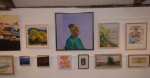
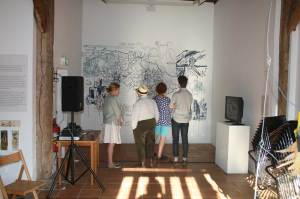
The Halesworth Gallery has an open show every autumn and I usually contribute something. I am on the committee and have been for the past ten year or so. This is a legacy from when I used to organise art shows in fields and marshes with a friend. In the end I got asked to be on the committees of a couple of art galleries in the town and this has been part of my being active in the local art community. Halesworth Gallery has been there since 1966 in an old alms house in the town. We show from May to September and put on about seven shows a year with a couple of shows of children’s work at the start and the end of the season. And we always have the Open Show.

This year I put in two square pieces which were supposed to be channelling Lily Van Der Stokker . Unfortunately I didn’t get down to Tate St Ives to see the show and they have been tardy in sending me the book but I read about it in magazines and online. I was intrigued by the idea that her work can be seen as being aggressive in its prettiness. I really like it. It appeals to me as it is clearly quite annoying whilst being very ‘nice’.

So I made one piece with water colour on the canvas using a frilly manner of calligraphy. It reads ‘A Painting to Cheer Everyone Up’. The other piece was made with thin acrylic over a layer of clay based house paint. It reads ‘How to Paint and Draw’. This is the title of one of the case studies and it was supposed to sit in the middle of the wall of varied open show type work and be a half question about the work around it. A low key intervention in the show really.

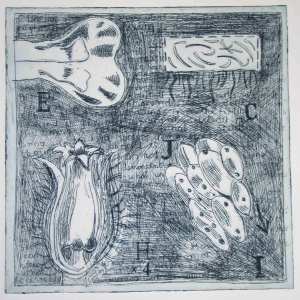
Botanical etching with obscuring layer of cross hatching.

Botanical etching with obscuring layer of cross hatching.

I spent Friday morning in the print workshop and pretty much wrecked the prints with an unnecessary layer of mark making on both. I wasn’t a very happy bunny by the end of it. The plate with the four botanical images on had a pentimenti on the flower head which was getting on my nerves. I should have blocked it out but I didn’t and it was a bit too much; not a very stylish bit of pentimenti. I wanted to tone it down and the writing too so I put on a layer of crosshatching which just mucked it up entirely- you can’t see the rather wonderful backward writing anymore and you can still see the pentimenti so that was a disaster.

I quite like the idea and the idea has evolved in the etching so I might rework it from scratch and without the cross hatching and with more coherent words.

The other print worked to a degree. I reworked the flower head and left it in the acid for a long time and that emphasised the image and obscured some of the writing more. The flower head is inverted, Baselitz style. It isn’t great though.

So, I have to ask myself how much this has been a worthwhile exercise. I have developed these two ideas through the process of etching. The layering of the mark making comes out of the process of putting a ground on, marking, printing, regrounding the plate and making more marks. I haven’t entirely controlled the process as well as I have with the  straighter drawing ones which I much prefer. I could prepare them more with Photoshop and so on, prepare the writing and so on. Though that works against the process leading to the idea. I could redo them as paintings or watercolours or monotypes.

The writing on the images is trying to get the voice of the artist, researcher and teacher into the work. And the idea of the images is to make work that directly relates to the (current) research question. These are supposed to be demonstrations, learning pieces. I am trying to learn about something so that I could teach it.

Some things have come out of these two pieces – the layering and the use of text. They could be laser cut prints like the cards I made. How the laser cutter would deal with a layered image might be interesting.
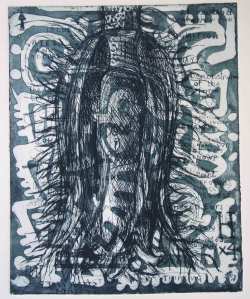
Second botanical plant image. Layers of abstract image made with Lascaux acrylic ground painted on and then car paint aqua tint with Dom. Further layers of writing and drawing through traditional grounds at NUCA.

What I tend to want to do is to be able to use a process so that I can improvise with it and have the process lead to ideas. I get frustrated if I can’t get the process to do that and if I feel that the process is dictating to me. I find the etching process quite awkward in itself which is interesting. It is slow and cumbersome and some of the etiquette is quite annoying.

Over the weekend I went over the Intaglio book and thought about what I was doing wrong. I also looked at the Edinburgh Printmakers website which has a nice easy guide to ‘safe’ printmaking, or at least safer.  The attraction is that this water based set of processes both makes etching much simpler as it just becomes about grounds and stopping out and also opens it out into something much more complex as the range of things you can use as grounds and stops is broadened out considerably.

One of the reasons why this has been quite difficult for me, I think, is because, as an art teacher, I have tended to learn new processes in a relatively simple, classroom friendly form. We can’t do a lot of welding but I can knock you up and nice Anthony Caro in heavy card board with a low melt glue gun. With etching I have learnt it in a fully professional workshop with all the facilities and safety gear and I have to re-invent it for doing it in the shed or classroom once all this is over. If it is to remain part of my practice anyway. Being able to make this sort of work in the shed would be different anyway. Having the process in your possession is different to driving twenty five miles to the art college, over caffinating myself in the many cafes near the art college and then driving home again. Talking to David and working with Dom this summer has made me think differently about it and I am looking for a way to take more control over the process.

I also started a large acrylic image based on the ideas developed in the etchings yesterday. I prepared a surface with a blue similar to the Lascaux ground that I used on the plates and painted on the Penck like image that I had thrown on to the copper plate at the summer school as a first layer. Today I have started to put the words on in similar blues.

Abstract layer based on the layer of mark making on the etching plate started at the summer school.

Do I want the writing to be legible? Or do I want it to be semi-legible? Or not at all legible? Just a sign of writing being there as a visual thing? What is the point of writing being there if it isn’t legible? A sort of mumbling.

The idea is that the thing will look like a page of notes from a learning journal in some way.

Wingfield Barns map

You should re-write the title of your project every couple of months or so to see how things have changed. So the subtitle has altered to reflect recent thinking. Considering the confirmation feedback over the last few weeks, mulling it over really and letting it sink in. It emerged in the meeting that the artist teacher bit was probably not the most interesting bit and there is an article in iJade this month which is very much about the artist teacher. It is looking a well trammelled bit of turf with Daichendt’s book Artist-Teacher. I think my interest is probably in a subsection of the general area of the artist-teacher, particularly the role of the demonstration in the classroom and the idea of the art work as demonstration.

For a lot of art teachers the only art work they make is the work they make to demonstrate ideas or techniques in the classroom. Could this be seen as an art practicee? Should art teachers value this sort of work as practice? Should art teachers just value this sort of work more?

If you make a lot of work in the classroom how much does that change your practice? The work might be demonstrating something to someone in the classroom which might be one category of work- actual performative demonstration in the classroom. Other sorts of demonstration can be the sort that I make anyway when I am thinking about how to do something in the classroom, when I am looking for a way in. The sets of Davie style drawings that I did on a PD day would be an example. Not necessarily made as classroom material or with the classroom in mind to start with but they became so as I made them and thought about them as a potential project. I did mono-prints as a prep for a project in the trialling phase which became the Sandra Blow project a couple of years ago.

If one makes a lot of work of this sort how far can this be said to ‘infect’ the art practice away from the classroom? There is a way in which I end up demonstrating things to myself in a way. But what am I demonstrating and why? The etchings are almost me demonstrating to myself how to make an etching. There is a sort of running commentary in my head unpacking the process of making them as I make them.

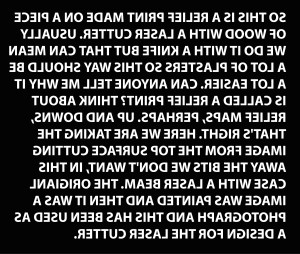
This week I prepared some digital files for the laser cutter at NUCA to see if it can cut type onto wood to make a relief print. Hand-cutting type or writing it backwards on an etching plate is going to be a drag.  The text is a monologue on the process of making the print as if I am telling year eight how to do one. The image is from a photo of one of the big ‘formal experiment’ brush drawings I did at the end of last term. The idea is to overlay one over the other with transparent ink. So the idea is to make this ‘teacher voice’ or ‘demonstrator’s voice’ part of the art work as it is in the big hand paintings. I would like to do it in the prints too.

Text for a laser cut print

One of the effects of the teaching practice has been to make the art practice extremely diverse. I now make work with a far wider range of materials and techniques than I did at college or before teaching. When I was at college I made video and film, made photos and did a lot of drawing, animation and painting and print. So I was always quite diverse in my art work but since entering teaching it has become even more diverse. This is partly because I have been a one man band in the school but I have had to teach the range of media and techniques that the National Curriculum requires. This has particularly taken me into 3D and sculpture which I had rarely done previously. At the moment we have a set of masks based on the work of Calixte Dakpogan on the wall along with a second set of Niki De Saint Phalle sculptures by year 8 being finished (they liked the year 6 ones and wanted to have a go) plus a very fine set of large scale Pop pieces based on Oldenburg and van Bruggen. Then there is all the ceramic work which is something I learnt how to do on the teacher training course at Middlesex and have developed since. Plus the textile work and the moulds and plaster work and so on and so on.

I learn something new to teach the pupils and then I will go off on one and make a series of things using that technique until I get bored or the next thing comes along and then I’ll go back to it later or perhaps not. The set of ceramic biscuits I made (biscuit fired) when I was into moulds for a year would be an example.

The need to teach a wide variety of techniques and artists keeps the work moving around and not really settling into one groove. This has become a feature of the work. No two shows the same.

The use of artists as deliberate influence must be a factor too, the use of styles and artist’s working methods in the classroom. The role of influence as a teaching and learning tool in the classroom is one part of the question but as far as the art practice is concerned it has an impact on how the work is done. It keeps it diverse too. I described it to Dom Theobald as running the working methods of various artists through my own practice. What effect does that have? How does that impact on my work and how I feel about it?

How to approach this then? My initial thinking is that I have to work more from the art practice. If the confirmation documentation was heavily dominated by educational research methods and ideas (which is where I come from) towards art practice but not really finding it (‘where is the art practice in this?’ question in the confirmation meetings) then really I have to explore the practice and connect it back to the classroom. The practice might be the shape it is because of the classroom and the habitual practice of teaching but it is still a distinct thing from the teaching practice, it does stand away from it.

I need to document and catalogue the art practice and describe it in its diversity. What shape does it have? I need to know more about practice as research and I need to spend the summer making work and reading up on that, a lot. The current case studies as they exist in the research seem somewhat limiting and they are too classroom focussed to be useful. They feel like millstones rather than stepping stones. And they have come to misrepresent the work in the classroom and that can’t be the right thing. So perhaps the classroom work with the pupils and there work can be more tangential and seen through their outcomes on display  more than anything else. The case studies exist in the way that they do due to the ethical procedures about using the images of the pupils and their words but there is less of a problem if just the final work is used in the report.

I feel more interested in this as a direction and more energised than I had been as I ploughed through the case study with the attendant over focus on the one artist. The project is supposed to be a practice based project and that is what I was originally interested in learning about when I started, art practice as research. I should be more confident about the practice and be happier to use it, funny, odd and diverse as it is, as the centre of the project.