Archives for category: Drawing

After the Christmas and New Year lay off I have got back into making the plates again. I made one last week which is another demonstration plate, showing a range of decorative ideas to help the pupils with their commemorative plates. I have had a lot of fun in libraries and museums following up research ideas and I have learnt a lot about pottery.

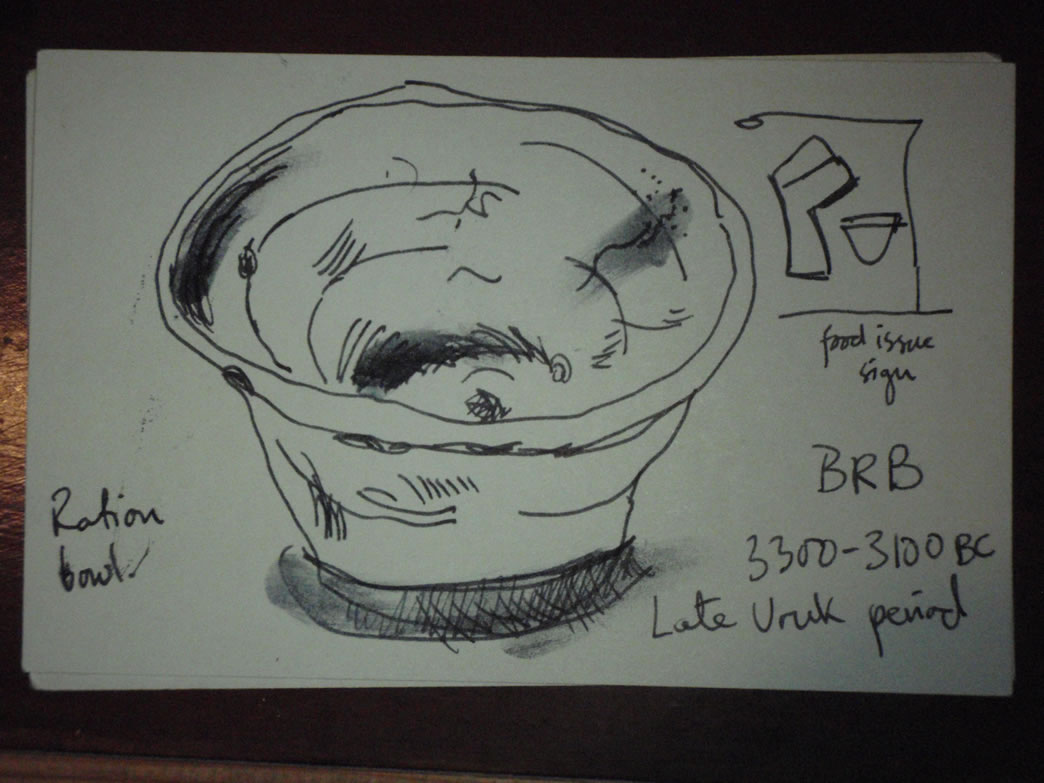
I was in London Friday and after the course finished I made it over to the British Museum for their late night opening. I was particularly after seeing a BRB, a bevelled rimmed bowl from Mesopotamia. I saw these on a BBC programme about the dawn of civilisation. They are apparently so plentiful around Tell Brak that the archeologists have to rebury the things. I made a little drawing of this really very humble object which is symbolic of a great deal.

It is thought to be a ration bowl because of the standardisation of the the size, pressed into a standard mould as they are. This implies that one group of people were being rationed by another group of people, that there were workers and overseers already. Social organisation inferred from a pot. Very interesting. I also found tin ware plates and a huge Thomas Toft platter and spent a couple of hours sketching.


An afternoon away from the hurly burly of school and being head of year eight. Relatively peaceful. I worked on two plates. One the still life that I printed last week of the Day of the Dead classroom and other bits and pieces. I put another layer of ground on it to rework it further. I also dipped the self portrait print that I had worked on in the classroom when the pupils had been working on their self portraits in their sketchbooks.

I had this brilliant idea to use up a lot of paint and the large card that is under a table at the back of the art room. We were all going to do a self portrait project based on Gormley and Quinn and drawing round ourselves and so on. The idea was that the outline was drawn directly from the body rather than being a depiction in the way that Gormley’s things are directly from him. That was my link anyway in formulating the idea. I thought of Klein and death masks and all sorts as I developed the idea. The first groups on Monday were under enthusiastic though and I gave up the presentation after the yawning and gazing out of the window got on my nerves and we drew a self portrait in our books instead. On Tuesday and Wednesday the groups were more positive and they quite enjoyed themselves with the large scale work and the message will have got round to the Monday groups, probably. Anyway, when the first groups were working in their sketchbooks I modelled concentration and observation and drew out a self portrait on a plate I had ready in the cupboard.

In the workshop I dipped it for a relatively restrained 50 minutes and printed from that. The result is OK – sketchy and relatively under worked compared to most of them. I intend to leave it at that and move on to another one.

Self portrait etching drawn from life Monday 4th October in school.

Looking through the sketchbook I can see that the Whiteread show has had an effect. I was varnishing some collagraphs and ended up varnishing some pages in the book and using scraps of spoilt paper as collage. I found some isometric paper on the desk and started using it to draw on as does Whiteread. I drew some improbable structures in idle moments, enjoying the puzzle like way they come together if you can keep using the isometric framework logically. I could see that the drawings might appeal to the sort of kid who is interested in drawing a s technical thing. I can remember being fascinated by the wonder of perspective and spending hours drawing street scenes and girders coming towards me and rockets going away from me and all that. I was always interested in the minutiae of learning to draw and illusionism is part of being ‘good at drawing’. When you are a kid is it much more? There is a sub-section of ‘being good at cartoons’ I guess. As I drew these improbable forms I realised they looked a lot like the drawings I did some years ago as part of a project based on plugs. All these things looping around and coming back to earlier ideas and connecting to the work of other artists and to learning to draw. I can see these insignificant drawings having these connections to learning to draw, inspired by Whiteread to pick up this isometric paper, linking back to an earlier body of work about plugs which I did with pupils and in my own work, and these link to Whiteread’s switch drawings which I had been unaware of. Complicated. And easily forgotten.
And in a couple of weeks I will have moved on to another mild obsession and these pages stained with the influence of Whiteread will be forgotten. It seems difficult to concentrate on anything for any length of time. This seems to be a feature of the work and the research. I have always been a bit like that any way. Discursive would be kind. Easily distracted more like it. This has helped me be a decent art teacher as my interests and influences are quite wide and I am technically versatile. But the downside is that my work flits about from one idea to another. This isn’t helped by the way it is produced within and around a timetable of hours, fitted into broken up days. We don’t let the kids get really focussed on something for a day or two and we don’t allow ourselves to either as we live these oddly fragmented days. I am beginning to realise that the project is an in depth look at work produced in fragments and I am beginning to see that the work can be left as fragments, left as unfinished ideas or partly done. The big self portrait painting I did as part of the Clemente week hasn’t been touched now for a fortnight or so. The last thing I did was put a bit of shellac into an eye. I don’t think it is going to get any further than it is and I think that is OK. It is what it is. I think that if I go over it or work on it more then I will be working on it with a feeling and interest which has moved on to something else.

Obviously having a holiday from a PHd is unlikely but the closest I got this summer was a few wet days in Canterbury reading Cloud Atlas and drawing in the crypt of the cathedral. How much of a holiday that is, exactly, reading a different sort of book and drawing a different sort of thing I am not sure. Why draw on holiday? Do all art teachers take drawing things with them? For this trip I took watercolour paper with me and bought another pad of it in Chromos in the city. I drew with pen and a couple with pencil and I got particularly interested in the ancient and very mysterious figures on the columns down in the crypt. These were called jugglers and griffins and so on but they are very weird things. Apparently dating back to 1100. Fun to draw in the gloom and no photography allowed so the only way to get an image is to squint and draw. Will I do something with them? Is there an etching in there? I’m not sure at all and I am not sure the exercise is aimed at that, gathering material. It slows the eye down and forces concentration and looking at something closely and that is enough in itself really. I have lots of these types of drawings from all sorts of odd places. A long standing habit.

When I first got interested in drawing and realised that there was something there that I had to learn how to do, that it was a skill to practice, then I became an inveterate reader of ‘how to draw’ books. This was when I was between twelve and sixteen, when I was working my way through the books in the Anstey library. There were books called ‘How to Paint and Draw’ which showed you everything there was to know about drawing and painting. I practised how to shade and how to make things ‘three dimensional’ and so on. I was fascinated by the possibilities but, somehow, never that brilliant at them. My work always looked a bit, sort of scruffy somehow. Certainly I remember that there were some people who were much better at pencil rendering than I could ever be. I couldn’t really see the point in copying a photograph in graphite. I never really got the fascination with photographic realisation with art materials. This may have been because my Dad is a photographer so my other obsession was getting the f-stops right on my Lubitel 2 (real photographers just use an exposure meter to check they’ve got it right, Paul). Why draw photographically when you can put a roll of Tri-X in your camera?

Probably my favourite ‘How to..’ books were two by the artist and illustrator Paul Hogarth, Creative Ink Drawing (1968 Studio Vista) and Creative Pencil Drawing (1964 Studio Vista). Not only did he have a nice line, a nice loose line, and a very un-photographic manner, he also had a great Romantic back story about fighting in the International Brigades and knocking about Europe after the war and drawing the ruins in Germany. Every drawing had a story to go with it. I even wrote the guy a letter and he was good enough to reply.

Amongst all this ‘advice’ everyone insisted that one should carry a sketchbook at all times. This all coincided with ‘O’ levels and being expected to have a sketchbook. I was thrilled with the A3 spiral bound book I had when I started the ‘O’ level course at Quorn Rawlins. It is a habit that has stuck, on the whole, ever since. My sketchbooks were adored on Foundation and fascinated other students on the degree. And since then I have generally had one knocking about. There are a row of them behind me, A5 Winsor and Newtons.

More recently the habit petered out. I chatted to friends who did not keep books as a matter of course and I started to feel that the books were too closed down and shuttered up, that a lot of energy went into them which could be more productively spent making things that were more out there and exhibitable. I would buy a book and it would not get used, a few drawings at the beginning and a few clippings and then nothing. There seemed less point in keeping a book to have ideas in that I didn’t have time to realise.

Looking at the show in NUCA though, that wall of pictures, I realised where the sketchbook had gone. I had just made it a lot bigger and on lots of bits of paper. The impulse to make work like that, in the way it had been in the old books, when I had a sketchbook habit, was there in the wall of work. With something else as well though, more public and confident.

The sketchbook is now a ‘learning journal’ which is sort of working alongside this blog and a written notebook and a little sketchbook and bits of card and watercolour paper and the etchings and two paintings.

Drawing on holiday seems to have something of that lad carrying a sketchbook all the time, like the books say you should, about it. I resist the temptation to ‘draw interesting characters you might see in the street or cafe’ these days so I might have moved on a bit. Of course, one of the things I am doing is sort of demonstrating to pupils that you should carry a sketchbook with you at all times and that a holiday can provide you with new and interesting drawing opportunities. Whilst I am extremely unlikely to ever deploy these Canterbury drawings in the classroom I am, at some level, perpetuating the same drawing habits that got me going when I was a lad.

Whilst I can see that in some ways this is a good thing I can also see it as being really quite naff. It is part of the half life of the picturesque, clicking away behind notions of how to draw.