The blog has been moribund as I have been preoccupied with the confirmation process at NUCA. I have got through this and I am now officially ‘writing up’. As I approached the confirmation meeting I re-read the 16,000 words that I had produced and realised that it wasn’t quite what I had meant, somehow. It was ever so slightly off my point, rather too much about the artist-teacher. This is pretty well-covered ground and it has been a problem in the research to deal with this, to find an angle on it.
During the meeting I was asked where the practice was in the research and where the researcher had disappeared to. It was all about the teacher bit and the relationship between the artist-teacher and the pupil’s progress. The problem is how do you access the impact of having a teacher make their own work in the classroom through the pupil’s progress. It isn’t very apparent necessarily. It might be more obvious in the sort of work that we do and, I think, some of the brio with which we do it.
The original inspiration for the research had been in looking at the sort of examplars that I made in the classroom to show the pupils what I meant or to show them a particular technique or idea. I have long thought that showing them ‘one I prepared earlier’ was borderline useless as it takes a skilled eye to be able to unpick how an image was actually made. It was more useful to see a piece of work being made before your very eyes and the only way to do that was to actually make work in front of the pupils. Doing this I think about how I learnt how to do something, it made my own learning more apparent to myself and better able to communicate this and the process helped me to anticipate the tricky bits. So, it has been a long standing habit to make work in front of and alongside the pupils. This sort of work though, made as it is with cheapish gouache on sugar paper or 1.99 watercolours on cartridge paper, I didn’t consider to be ‘my work’. I had my own paintings and so on and then I had this utilitarian work I made in class. I didn’t value it as part of my art practice but then again, I nearly always finished the work and I didn’t throw it away either. So I valued it in some way.
I never threw it away because I remember an art teacher showing us how to throw a pot and then knocking it over when he had done and we were shocked and disturbed that he did this. I was about twelve. He said he had lots of pots at home but it still seemed shocking to be able to make something like that but not value the outcome. So I don’t throw them away and I tend to finish them. I give them away sometimes, to adults, not pupils. I let the frost destroy the pots in the garden and I keep the 45 or so self-portraits in the manner of Modigliani amongst the drifts of work in the art room.
So the original interest in the research was, what happens if you take this under valued part of art making, this stream of utilitarian things made to show someone, and make that the art practice. Could it be considered part of an art practice? For a lot of art teachers it is the only art practice they have got. Should we value it more? What is different about making an art work in order to show someone how to do something or to show them an idea? What do they exemplify? Are you making examples for yourself and what might that mean?
We discussed this in the confirmation meeting and we agreed that was probably more interesting than what I had actually written. The nice thing about it is that it puts the practice back into it and stops me having to try to show that my painting a picture two years ago may, or may not, have impacted on a thirteen year old in some ill-defined way.
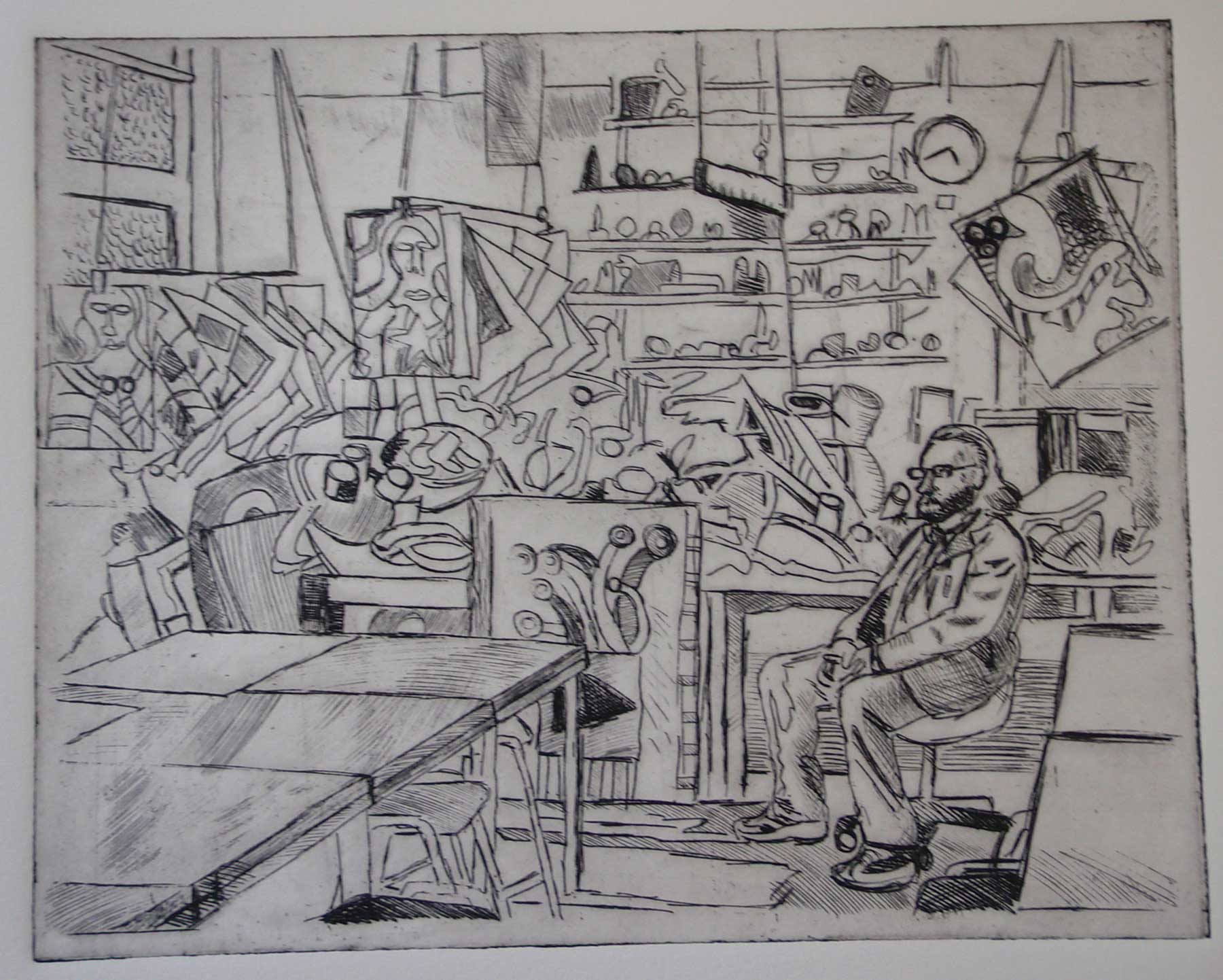
I have also had a show at NUCA of this sort of work and I will post pictures of this soon. What cam out of this was that everyone seemed to quite like the etchings for their awkwardness and intensity as much as anything. So I am writing this as a plate steeps. One of the 10 x 8 plates that I had before Christmas and that got subsumed in 16,000 academic words. It is based on a photo of myself sitting in the art room as studio that I made for the Artist and their Studio show at SCVA. It is an attempt to use a photo as a basis for a print.



 Can You Tidy Up Now Please?